
Textbook Question
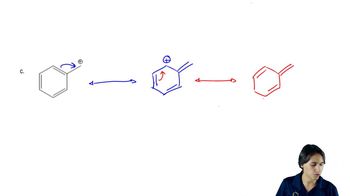
Explain why each compound is aromatic, antiaromatic, or nonaromatic.
(d)
(e)
(f)
1
views

 Verified step by step guidance
 1:45
1:45
 03:04
03:04 03:54
03:54Explain why each compound is aromatic, antiaromatic, or nonaromatic.
(d)
(e)
(f)
Explain why each compound is aromatic, antiaromatic, or nonaromatic.
(a)
(b)
(c)
a. Explain how pyrrole is isoelectronic with the cyclopentadienyl anion.
b. Specifically, what is the difference between the cyclopentadienyl anion and pyrrole?
The polarization of a carbonyl group can be represented by a pair of resonance structures:
Cyclopropenone and cycloheptatrienone are more stable than anticipated. Cyclopentadienone, however, is relatively unstable and rapidly undergoes a Diels–Alder dimerization. Explain.
Explain why each compound is aromatic, antiaromatic, or nonaromatic.
(g)
(h)
Draw resonance forms to show the charge distribution on the pyrrole structure.