Ch. 15 - Reactions of Carboxylic Acids and Carboxylic Acid Derivatives
Bruice - Organic Chemistry 8th Edition
Bruice8th EditionOrganic ChemistryISBN: 9780135213711Not the one you use?Change textbook
Chapter 16, Problem 51c

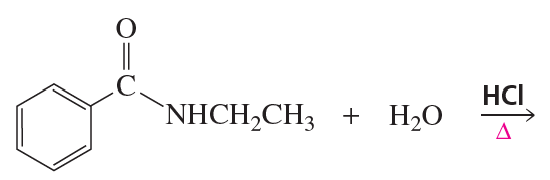
What compounds are obtained from the following hydrolysis reactions?
c. Chemical structure showing a benzene ring with an amide group, water, and hydrochloric acid for hydrolysis reactions.

Verified step by step guidance
1
Identify the functional group in the starting compound that will undergo hydrolysis. Hydrolysis typically involves breaking a bond in the presence of water, often targeting esters, amides, nitriles, or acid derivatives.
Determine the type of hydrolysis reaction. Since HCl is present, this is an acidic hydrolysis reaction. Acidic hydrolysis typically involves protonation of the functional group to make it more susceptible to nucleophilic attack by water.
Write the mechanism for the hydrolysis reaction. For example, if the compound is an ester, the carbonyl oxygen is protonated by HCl, making the carbonyl carbon more electrophilic. Water then attacks the carbonyl carbon, leading to the formation of a tetrahedral intermediate.
Break the bond between the carbonyl carbon and the leaving group (e.g., an alcohol or amine group, depending on the starting compound). This step results in the formation of a carboxylic acid and the corresponding leaving group.
Analyze the products formed. For example, if the starting compound is an ester, the products will be a carboxylic acid and an alcohol. If it is an amide, the products will be a carboxylic acid and an amine or ammonia.

Verified video answer for a similar problem:

This video solution was recommended by our tutors as helpful for the problem above.
Was this helpful?

Key Concepts

Here are the essential concepts you must grasp in order to answer the question correctly.

Hydrolysis

Hydrolysis is a chemical reaction in which water is used to break down a compound. In organic chemistry, it often involves the cleavage of bonds in larger molecules, resulting in the formation of smaller molecules or ions. This process is crucial for understanding how various organic compounds, such as esters and amides, react in the presence of water, especially under acidic or basic conditions.
Recommended video:
1:00
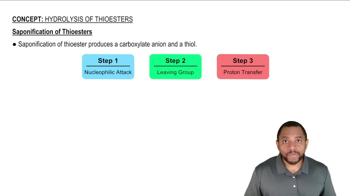
Hydrolysis of Thioesters Concept 2

Acid-Base Catalysis

Acid-base catalysis refers to the acceleration of a chemical reaction by the presence of an acid or a base. In the context of hydrolysis, an acid like HCl can donate protons (H+) to facilitate the breakdown of a compound, making it easier for water to attack and cleave the bonds. This concept is essential for predicting the products of hydrolysis reactions, as the nature of the acid can influence the reaction pathway and the resulting compounds.
Recommended video:
2:50
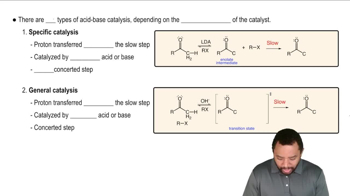
Acid-Base Catalysis Concept 3

Reaction Products

The products of a chemical reaction are the substances formed as a result of the reaction. In hydrolysis reactions, the products depend on the structure of the starting compound and the conditions of the reaction. Understanding how to predict these products is vital for organic chemistry, as it allows chemists to determine the outcomes of reactions and the potential applications of the resulting compounds.
Recommended video:
Guided course
11:07
Bridged-Products