Based on your answer to Assessment 12.8, which bases would you expect to be good leaving groups?
Verified step by step guidance
1
Understand the concept of a leaving group: A leaving group is an atom or group of atoms that can depart with a pair of electrons during a chemical reaction, such as a substitution or elimination reaction. Good leaving groups are typically weak bases because they can stabilize the negative charge after leaving.
Recall the relationship between basicity and leaving group ability: The weaker the base, the better it is as a leaving group. This is because weak bases are more stable on their own after leaving the molecule.
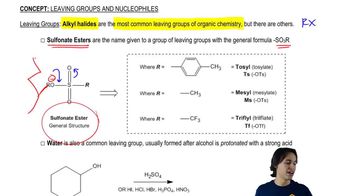
Identify common good leaving groups: Examples of good leaving groups include halides like Cl⁻, Br⁻, and I⁻, as well as neutral molecules like H₂O (from protonated alcohols) and sulfonate esters like tosylate (TsO⁻). These groups are weak bases and can stabilize the negative charge effectively.
Consider the pKa of the conjugate acid: The strength of a base is inversely related to the pKa of its conjugate acid. For example, HCl (pKa ≈ -7) has a very low pKa, making Cl⁻ a weak base and a good leaving group. Compare the pKa values of the conjugate acids to determine which bases are weak and thus good leaving groups.
Apply this knowledge to the bases mentioned in Assessment 12.8: Review the bases discussed in the assessment and evaluate their basicity and the stability of their conjugate acids. Identify which of these bases are weak and would therefore act as good leaving groups in a reaction.
Verified video answer for a similar problem:
This video solution was recommended by our tutors as helpful for the problem above
Video duration:
1m
Play a video:
0 Comments
Key Concepts
Here are the essential concepts you must grasp in order to answer the question correctly.
Leaving Groups
Leaving groups are atoms or groups of atoms that can depart from a molecule during a chemical reaction, typically in nucleophilic substitution or elimination reactions. A good leaving group is one that can stabilize the negative charge or lone pair it acquires after leaving, often resulting in a more favorable reaction pathway. Common examples include halides (like Cl⁻, Br⁻, and I⁻) and sulfonate groups (like TsO⁻).
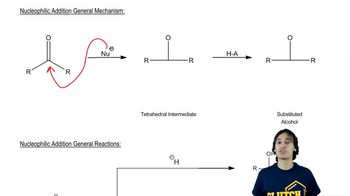
Nucleophilicity refers to the ability of a species to donate an electron pair to an electrophile, forming a new bond. Strong nucleophiles are often associated with good leaving groups, as they can effectively attack the electrophile after the leaving group departs. Factors influencing nucleophilicity include charge, electronegativity, and solvent effects, which can enhance or diminish a nucleophile's reactivity.
The stability of a leaving group is crucial in determining its effectiveness during a reaction. A stable leaving group can better accommodate the negative charge or lone pair it acquires upon leaving, making the reaction more favorable. Generally, weaker bases are better leaving groups because they are more stable in their anionic form, such as water (H₂O) and halides, compared to stronger bases like hydroxide (OH⁻).