Ch. 12 - Substitution and Elimination: Reactions of Haloalkanes
Mullins - Organic Chemistry: A Learner Centered Approach 1st Edition
Mullins1st EditionOrganic Chemistry: A Learner Centered ApproachISBN: 9780137566471Not the one you use?Change textbook
Chapter 11, Problem 24a

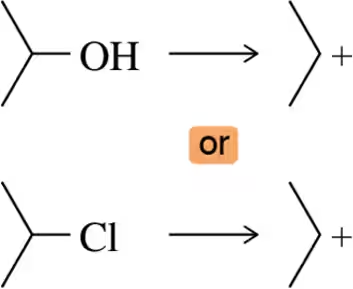
Formation of the carbocation should be fastest for which leaving group?
(a) Comparison of leaving groups OH and Cl in a reaction, highlighting the faster formation of a carbocation.

Verified step by step guidance
1
Identify the factors that influence the rate of carbocation formation. The rate of carbocation formation depends on the stability of the carbocation intermediate and the ability of the leaving group to depart. A good leaving group is one that can stabilize the negative charge after leaving.
Examine the leaving groups in the given options. A good leaving group is typically a weak base, as weak bases are more stable on their own. For example, halides like Cl⁻, Br⁻, and I⁻ are common leaving groups, with I⁻ being the best due to its larger size and better charge distribution.
Consider the stability of the carbocation formed after the leaving group departs. Carbocation stability increases in the order: methyl < primary < secondary < tertiary. Additionally, resonance stabilization or inductive effects can further stabilize the carbocation.
Compare the leaving groups in the given options based on their ability to leave and the stability of the resulting carbocation. The leaving group that departs most easily and forms the most stable carbocation will result in the fastest carbocation formation.
Conclude which leaving group leads to the fastest carbocation formation by combining the analysis of leaving group ability and carbocation stability. Ensure to consider both steric and electronic effects in your evaluation.

Verified video answer for a similar problem:

This video solution was recommended by our tutors as helpful for the problem above.
Video duration:
1m
Was this helpful?

Key Concepts

Here are the essential concepts you must grasp in order to answer the question correctly.

Carbocation Stability

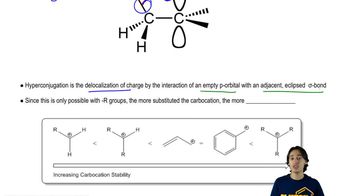
Carbocations are positively charged carbon species that can be formed during various organic reactions. Their stability is influenced by the degree of substitution; tertiary carbocations are more stable than secondary, which are more stable than primary. This stability affects the rate of formation, as more stable carbocations can form more readily, making them crucial in determining the fastest reaction pathway.
Recommended video:
Guided course
05:58
Determining Carbocation Stability

Leaving Groups

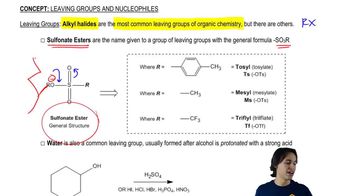
A leaving group is an atom or group that can depart from the parent molecule during a chemical reaction, taking with it the electrons from the bond. The ability of a leaving group to stabilize the negative charge after departure is key; good leaving groups, such as halides or sulfonates, are typically weak bases. The quality of the leaving group directly impacts the rate of carbocation formation.
Recommended video:
Guided course
07:22
The 3 important leaving groups to know.

Reaction Mechanisms

Understanding reaction mechanisms is essential for predicting how and why reactions occur. In the context of carbocation formation, mechanisms such as SN1 and SN2 illustrate how the leaving group influences the rate of reaction. The SN1 mechanism, which involves the formation of a carbocation intermediate, highlights the importance of both the stability of the carbocation and the nature of the leaving group in determining reaction speed.
Recommended video:
Guided course
02:16
Heck Reaction Mechanism