Ch. 13 - Nuclear Magnetic Resonance Spectroscopy
Wade - Organic Chemistry 9th Edition
Wade9th EditionOrganic ChemistryISBN: 9780135213728Not the one you use?Change textbook
Chapter 13, Problem 18a,b

Predict the theoretical number of different NMR signals produced by each compound, and give approximate chemical shifts. Point out any diastereotopic relationships.
a. 2-bromobutane
b. cyclopentanol

Verified step by step guidance
1
Step 1: Analyze the molecular structure of 2-bromobutane. Identify the unique hydrogen environments by considering symmetry and connectivity. Note that the presence of the bromine atom can influence the chemical shifts due to its electronegativity.
Step 2: Determine the theoretical number of NMR signals for 2-bromobutane. Look for equivalent hydrogens (hydrogens in the same chemical environment) and consider diastereotopic relationships, which arise when hydrogens are in non-equivalent environments due to chirality or asymmetry.
Step 3: Approximate the chemical shifts for each unique hydrogen environment in 2-bromobutane. For example, hydrogens near the bromine atom will experience deshielding and appear downfield (higher ppm), while hydrogens further away will appear upfield (lower ppm).
Step 4: Analyze the molecular structure of cyclopentanol. Identify the unique hydrogen environments, considering the hydroxyl group (-OH) and the ring structure. Note that the hydroxyl group can cause hydrogen bonding, which affects chemical shifts.
Step 5: Determine the theoretical number of NMR signals for cyclopentanol and approximate the chemical shifts. Consider the influence of the hydroxyl group and the ring strain on the chemical environment of the hydrogens. Point out any diastereotopic relationships, such as hydrogens on the same carbon but in different spatial environments due to the ring structure.

Verified video answer for a similar problem:

This video solution was recommended by our tutors as helpful for the problem above.
Video duration:
8m
Was this helpful?

Key Concepts

Here are the essential concepts you must grasp in order to answer the question correctly.

NMR Signals

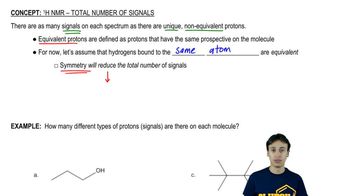
Nuclear Magnetic Resonance (NMR) spectroscopy is a technique used to observe the local magnetic fields around atomic nuclei. The number of distinct NMR signals corresponds to the number of unique hydrogen environments in a molecule. Each unique environment produces a separate signal, allowing chemists to deduce structural information about the compound.
Recommended video:
Guided course
04:35
General Assumption for 1H NMR Signals

Chemical Shifts

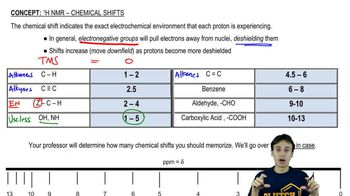
Chemical shifts in NMR spectroscopy refer to the resonant frequency of a nucleus relative to a standard in a magnetic field, typically measured in parts per million (ppm). These shifts provide insight into the electronic environment surrounding the nuclei, influenced by factors such as electronegativity and hybridization. Understanding typical chemical shift ranges for different functional groups is essential for predicting the signals in a spectrum.
Recommended video:
Guided course
11:44
1H NMR Chemical Shifts

Diastereotopic Relationships

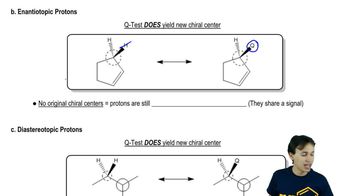
Diastereotopic protons are non-equivalent protons in a molecule that are not related by symmetry and can give rise to different NMR signals. Identifying diastereotopic relationships is crucial for understanding the stereochemistry of a compound, as these relationships can affect the chemical shifts and splitting patterns observed in the NMR spectrum. Recognizing these distinctions helps in accurately interpreting the NMR data.
Recommended video:
Guided course
11:40
Q-Test (Proton Relationships)