
Ch. 13 - Nuclear Magnetic Resonance Spectroscopy
Wade - Organic Chemistry 9th Edition
Wade9th EditionOrganic ChemistryISBN: 9780135213728Not the one you use?Change textbook
Chapter 13, Problem 12

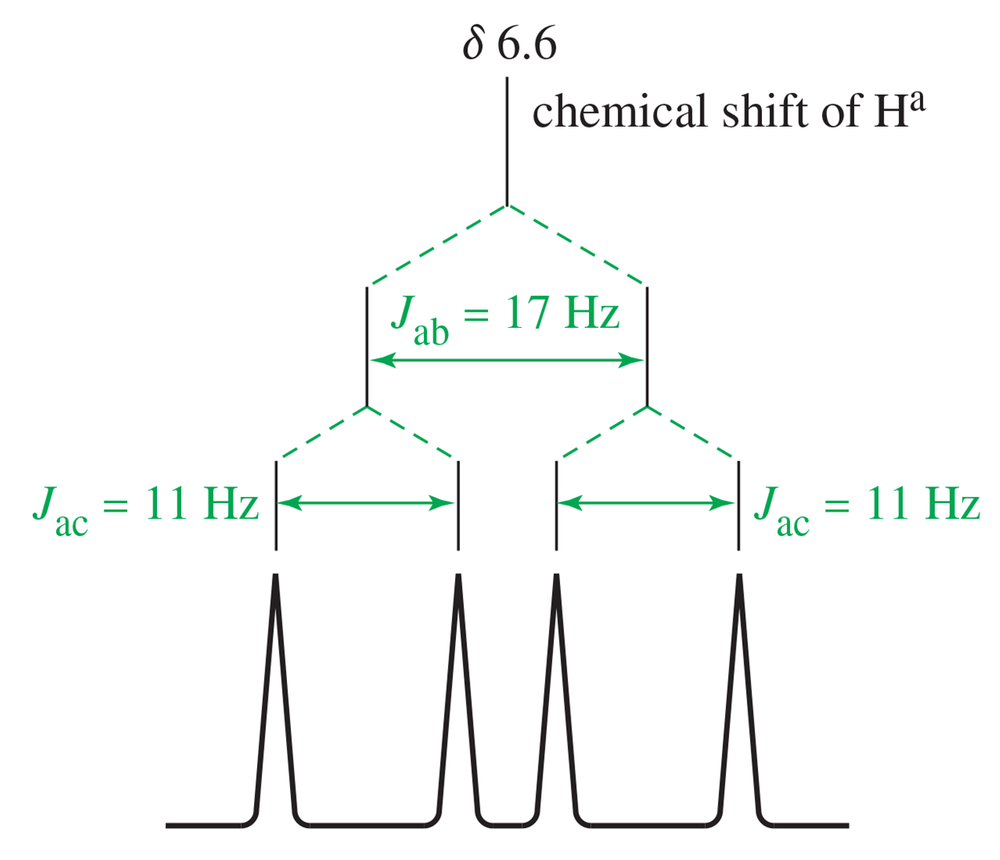
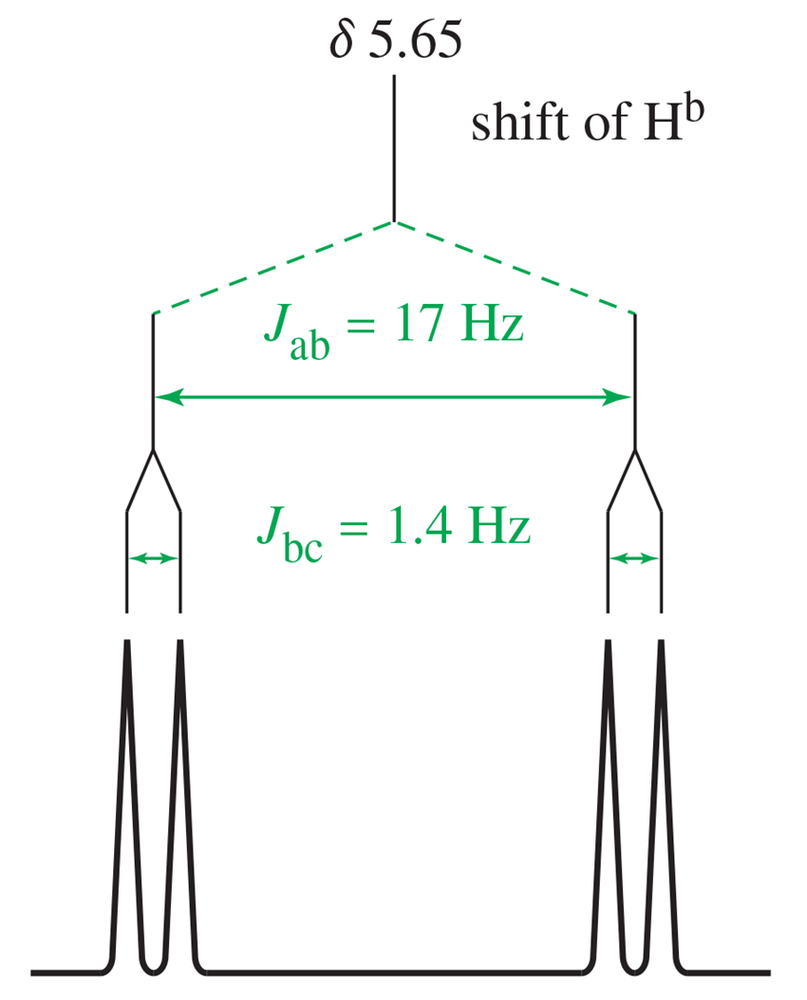
Draw a splitting tree, similar to Figures 13-32 and 13-33, for proton Hc in styrene. What is the chemical shift of proton Hc?

Verified step by step guidance
1
Identify the proton Hc in styrene. Styrene is an aromatic compound with a vinyl group attached to a benzene ring. Proton Hc is typically one of the protons in the vinyl group adjacent to the benzene ring.
Determine the coupling partners for proton Hc. In styrene, proton Hc will couple with the other protons in the vinyl group (Ha and Hb). Analyze the number of neighboring protons and their spin states to predict the splitting pattern.
Construct the splitting tree for proton Hc. Start with the initial peak for Hc, then split it based on the coupling with Ha (typically a doublet due to one neighboring proton). Next, split each peak of the doublet further due to coupling with Hb (another doublet, resulting in a doublet of doublets).
Estimate the chemical shift of proton Hc. The chemical shift depends on the electronic environment of Hc. Since Hc is part of the vinyl group adjacent to the benzene ring, it will experience deshielding due to the electron-withdrawing effect of the aromatic ring. This places its chemical shift in the range of approximately 5-6 ppm in a typical NMR spectrum.
Verify the splitting pattern and chemical shift using experimental data or reference spectra for styrene. Compare the predicted splitting tree and chemical shift with known values to ensure accuracy.

Verified video answer for a similar problem:

This video solution was recommended by our tutors as helpful for the problem above.
Video duration:
7m
Was this helpful?

Key Concepts

Here are the essential concepts you must grasp in order to answer the question correctly.

Chemical Shift

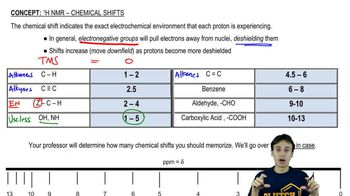
Chemical shift refers to the change in the resonant frequency of a nucleus in a magnetic field, influenced by the electronic environment surrounding it. In NMR spectroscopy, it is measured in parts per million (ppm) and provides insight into the molecular structure and the electronic effects of nearby atoms or groups. For protons, the chemical shift can indicate the presence of electronegative atoms or the degree of substitution in aromatic systems.
Recommended video:
Guided course
11:44
1H NMR Chemical Shifts

Splitting Patterns

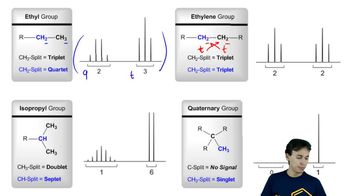
Splitting patterns in NMR arise from the interaction of non-equivalent neighboring protons, which causes the resonance signals to split into multiple peaks. This phenomenon, known as spin-spin coupling, provides information about the number of adjacent protons and their arrangement. Understanding these patterns is crucial for interpreting the NMR spectrum and deducing the structure of the compound.
Recommended video:
Guided course
08:06
Common Splitting Patterns

Aromatic Protons

Aromatic protons are those attached to carbon atoms in an aromatic ring, such as styrene. These protons typically exhibit unique chemical shifts due to the delocalized π-electrons in the aromatic system, which influence their electronic environment. The presence of substituents on the aromatic ring can further modify the chemical shifts and splitting patterns of these protons, making their analysis essential for structural determination.
Recommended video:
Guided course
08:19
Intro to Aromaticity