Ch. 6 - Stereoisomerism: Arrangement of Atoms in Space
Mullins - Organic Chemistry: A Learner Centered Approach 1st Edition
Mullins1st EditionOrganic Chemistry: A Learner Centered ApproachISBN: 9780137566471Not the one you use?Change textbook
Chapter 5, Problem 12f

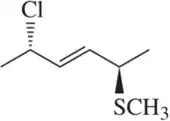
Identify the following molecules as chiral or achiral. If chiral, draw the nonsuperimposable mirror image and verify its nonsuperimposability.
(f) Chemical structure of a molecule with a chlorine atom and a sulfur atom, used to identify chirality.

Verified step by step guidance
1
Step 1: Understand the concept of chirality. A molecule is chiral if it has a non-superimposable mirror image, meaning it lacks an internal plane of symmetry. Achiral molecules, on the other hand, have a plane of symmetry and are superimposable on their mirror images.
Step 2: Examine the structure of the molecule provided in part (f). Look for a carbon atom bonded to four different substituents (a stereogenic center). If such a carbon exists, the molecule is likely chiral.
Step 3: If the molecule is chiral, draw its mirror image by reflecting all substituents across a vertical plane. Ensure that the spatial arrangement of substituents is accurately mirrored.
Step 4: Verify nonsuperimposability by attempting to align the original molecule with its mirror image. Rotate and translate the structures in your mind or on paper to confirm that they cannot be superimposed.
Step 5: If the molecule is achiral, identify the plane of symmetry within the structure. This symmetry ensures that the molecule is superimposable on its mirror image.

Verified video answer for a similar problem:

This video solution was recommended by our tutors as helpful for the problem above.
Video duration:
6m
Was this helpful?

Key Concepts

Here are the essential concepts you must grasp in order to answer the question correctly.

Chirality

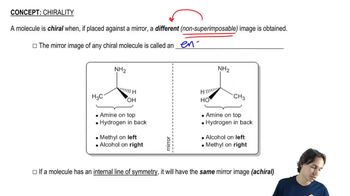
Chirality refers to the geometric property of a molecule that makes it non-superimposable on its mirror image. A chiral molecule typically has a carbon atom bonded to four different substituents, resulting in two distinct forms known as enantiomers. These enantiomers can exhibit different optical activities, meaning they rotate plane-polarized light in opposite directions.
Recommended video:
Guided course
05:10
What is chirality?

Nonsuperimposable Mirror Images

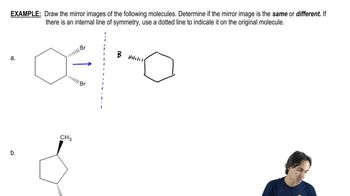
Nonsuperimposable mirror images are pairs of structures that cannot be aligned perfectly, even when rotated or flipped. This property is crucial for identifying chirality; if a molecule and its mirror image can be superimposed, the molecule is achiral. To verify nonsuperimposability, one can use models or drawings to demonstrate that the two forms cannot be made to coincide.
Recommended video:
Guided course
03:24
Drawing Mirror Images and Determining Chirality

Stereoisomerism

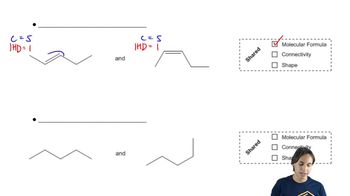
Stereoisomerism is a form of isomerism where molecules have the same molecular formula and connectivity but differ in the spatial arrangement of atoms. This includes chiral molecules, which can exist as enantiomers, and other types such as diastereomers. Understanding stereoisomerism is essential for recognizing the implications of chirality in chemical reactions and biological activity.
Recommended video:
Guided course
01:58
Determining when molecules are stereoisomers.