Ch. 17 - Reactions at the Alpha-Carbon
Bruice - Organic Chemistry 8th Edition
Bruice8th EditionOrganic ChemistryISBN: 9780135213711Not the one you use?Change textbook
Chapter 18, Problem 60a

Using cyclopentanone as the reactant, show the product of a. acid-catalyzed keto–enol interconversion.

Verified step by step guidance
1
Identify the structure of cyclopentanone. Cyclopentanone is a cyclic ketone with a five-membered ring and a carbonyl group (C=O).
Understand the concept of keto-enol interconversion. This is a tautomerization process where a ketone (keto form) is converted into its enol form (a compound with a hydroxyl group (-OH) attached to a carbon-carbon double bond).
In the presence of an acid catalyst, the carbonyl oxygen of cyclopentanone is protonated, forming an oxonium ion. This step increases the electrophilicity of the carbonyl carbon.
A proton is abstracted from an adjacent alpha-carbon (a carbon directly attached to the carbonyl group), leading to the formation of a double bond between the alpha-carbon and the carbonyl carbon. Simultaneously, the oxonium ion loses a proton, resulting in the formation of the enol form.
The final product is the enol tautomer of cyclopentanone, which consists of a hydroxyl group (-OH) attached to one of the carbons in the five-membered ring, and a double bond between the alpha-carbon and the carbonyl carbon.

Verified video answer for a similar problem:

This video solution was recommended by our tutors as helpful for the problem above.
Video duration:
2m
Was this helpful?

Key Concepts

Here are the essential concepts you must grasp in order to answer the question correctly.

Keto-Enol Tautomerism

Keto-enol tautomerism is a chemical equilibrium between a keto form (a carbonyl compound) and its corresponding enol form (an alcohol with a double bond). In this process, the hydrogen atom shifts from the carbon adjacent to the carbonyl to the oxygen, resulting in the formation of the enol. This concept is crucial for understanding how cyclopentanone can interconvert between its keto and enol forms under acidic conditions.
Recommended video:
Guided course
05:11
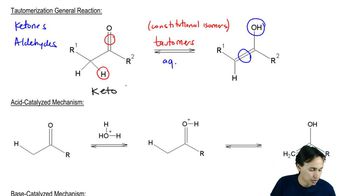
Tautomerization Mechanisms

Acid-Catalyzed Reaction

An acid-catalyzed reaction involves the use of an acid to increase the rate of a chemical reaction. In the case of keto-enol interconversion, the acid protonates the carbonyl oxygen, making the carbonyl carbon more electrophilic and facilitating the transfer of the hydrogen atom. This catalytic process is essential for promoting the formation of the enol from the keto form of cyclopentanone.
Recommended video:
Guided course
03:09
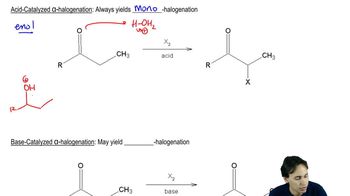
Acid Catalyzed

Cyclopentanone Structure

Cyclopentanone is a cyclic ketone with a five-membered ring structure containing a carbonyl group (C=O). Its unique ring structure influences the stability and reactivity of the keto and enol forms. Understanding the molecular structure of cyclopentanone is vital for predicting the outcomes of its reactions, including the keto-enol tautomerization process.
Recommended video:
Guided course
03:04
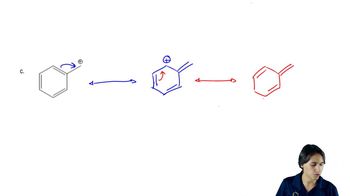
Drawing Resonance Structures