
Ch. 17 - Reactions at the Alpha-Carbon
Bruice - Organic Chemistry 8th Edition
Bruice8th EditionOrganic ChemistryISBN: 9780135213711Not the one you use?Change textbook
Chapter 18, Problem 64b

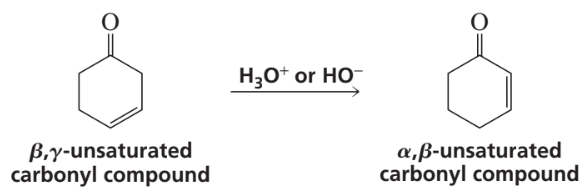
A β-ɣ-unsaturated carbonyl compound rearranges to a more stable conjugated ⍺,β-unsaturated compound in the presence of either acid or base. b. Propose a mechanism for the acid-catalyzed rearrangement.
Rearrangement of a β-ɣ-unsaturated carbonyl compound to a more stable α,β-unsaturated compound with acid or base.

Verified step by step guidance
1
Step 1: Protonation of the carbonyl oxygen occurs in the presence of the acid (H₃O⁺), making the carbonyl group more electrophilic. This step increases the reactivity of the molecule and prepares it for rearrangement.
Step 2: A resonance-stabilized carbocation is formed by shifting the π-electrons of the double bond towards the positively charged carbonyl carbon. This creates a new intermediate with a positive charge on the β-carbon.
Step 3: A hydride shift or proton transfer occurs from the β-carbon to the α-carbon, stabilizing the carbocation and forming a new double bond between the α- and β-carbons. This step is crucial for the rearrangement to the conjugated structure.
Step 4: Deprotonation of the hydroxyl group (formed during protonation) occurs, regenerating the acid catalyst and completing the rearrangement. The molecule now exists as a conjugated α,β-unsaturated carbonyl compound.
Step 5: The final product is stabilized due to conjugation between the carbonyl group and the double bond, which lowers the overall energy of the molecule and makes it more thermodynamically favorable.

Verified video answer for a similar problem:

This video solution was recommended by our tutors as helpful for the problem above.
Video duration:
2m
Was this helpful?

Key Concepts

Here are the essential concepts you must grasp in order to answer the question correctly.

b,g-Unsaturated Carbonyl Compounds

b,g-Unsaturated carbonyl compounds contain a carbonyl group (C=O) adjacent to a double bond (C=C). This structure allows for unique reactivity, particularly in rearrangements and tautomerizations, where the stability of the conjugated system can drive the reaction. Understanding the electronic and steric factors influencing these compounds is crucial for predicting their behavior in acid or base-catalyzed reactions.
Recommended video:
Guided course
01:15
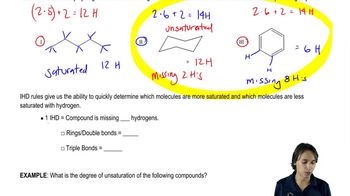
What index of hydrogen deficiency is.

Acid-Catalyzed Mechanism

In acid-catalyzed reactions, protons (H+) from the acid facilitate the rearrangement of the substrate. The mechanism typically involves protonation of the carbonyl oxygen, increasing its electrophilicity, followed by nucleophilic attack by the double bond. This process can lead to the formation of more stable conjugated systems, as seen in the rearrangement of b,g-unsaturated carbonyl compounds.
Recommended video:
Guided course
06:34
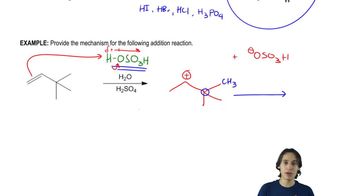
Acid-catalyzed hydration mechanism

Tautomerization

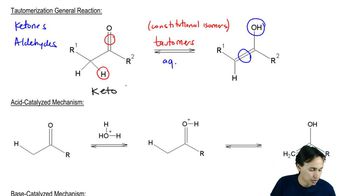
Tautomerization is a chemical reaction that involves the transfer of a proton and the rearrangement of bonds, resulting in the interconversion of structural isomers. In the context of b,g-unsaturated carbonyl compounds, tautomerization can lead to the formation of more stable isomers, such as a,b-unsaturated carbonyl compounds. This process is often facilitated by acid or base, highlighting the importance of proton transfer in organic reactions.
Recommended video:
Guided course
05:11
Tautomerization Mechanisms