Ch. 22 - Catalysis in Organic Reactions and in Enzymatic Reactions
Bruice - Organic Chemistry 8th Edition
Bruice8th EditionOrganic ChemistryISBN: 9780135213711Not the one you use?Change textbook
Chapter 23, Problem 33

The deuterium kinetic isotope effect (kH2O/kD2O) for the hydrolysis of aspirin is 2.2. What does this tell you about the kind of catalysis exerted by the ortho-carboxyl substituent? (Hint: It is easier to break an O–H bond than an O–D bond.)

Verified step by step guidance
1
Understand the concept of the kinetic isotope effect (KIE): The KIE is the ratio of reaction rates for isotopically substituted molecules. Here, kH2O/kD2O = 2.2 indicates that the reaction involving H2O is faster than the one involving D2O. This suggests that breaking the O-H bond is easier than breaking the O-D bond due to the lower bond dissociation energy of O-H compared to O-D.
Recognize the role of the ortho-carboxyl substituent: The ortho-carboxyl group in aspirin can act as a catalyst by participating in proton transfer or hydrogen bonding, which facilitates the hydrolysis reaction. The observed KIE suggests that the breaking of an O-H bond is a rate-determining step in the reaction.
Interpret the significance of the KIE value: A KIE of 2.2 is consistent with a primary kinetic isotope effect, which occurs when the bond to the isotopically substituted atom (H or D) is directly involved in the rate-determining step. This implies that the ortho-carboxyl group is likely involved in a proton transfer step during the hydrolysis of aspirin.
Relate the KIE to the mechanism of catalysis: The ortho-carboxyl substituent may stabilize the transition state by donating or accepting a proton, which involves breaking an O-H bond. The slower reaction in D2O (due to the stronger O-D bond) supports this mechanism.
Conclude the type of catalysis: Based on the KIE and the role of the ortho-carboxyl group, the catalysis exerted by the ortho-carboxyl substituent is likely general acid-base catalysis, where proton transfer plays a critical role in facilitating the hydrolysis reaction.

Verified video answer for a similar problem:

This video solution was recommended by our tutors as helpful for the problem above.
Was this helpful?

Key Concepts

Here are the essential concepts you must grasp in order to answer the question correctly.

Kinetic Isotope Effect (KIE)

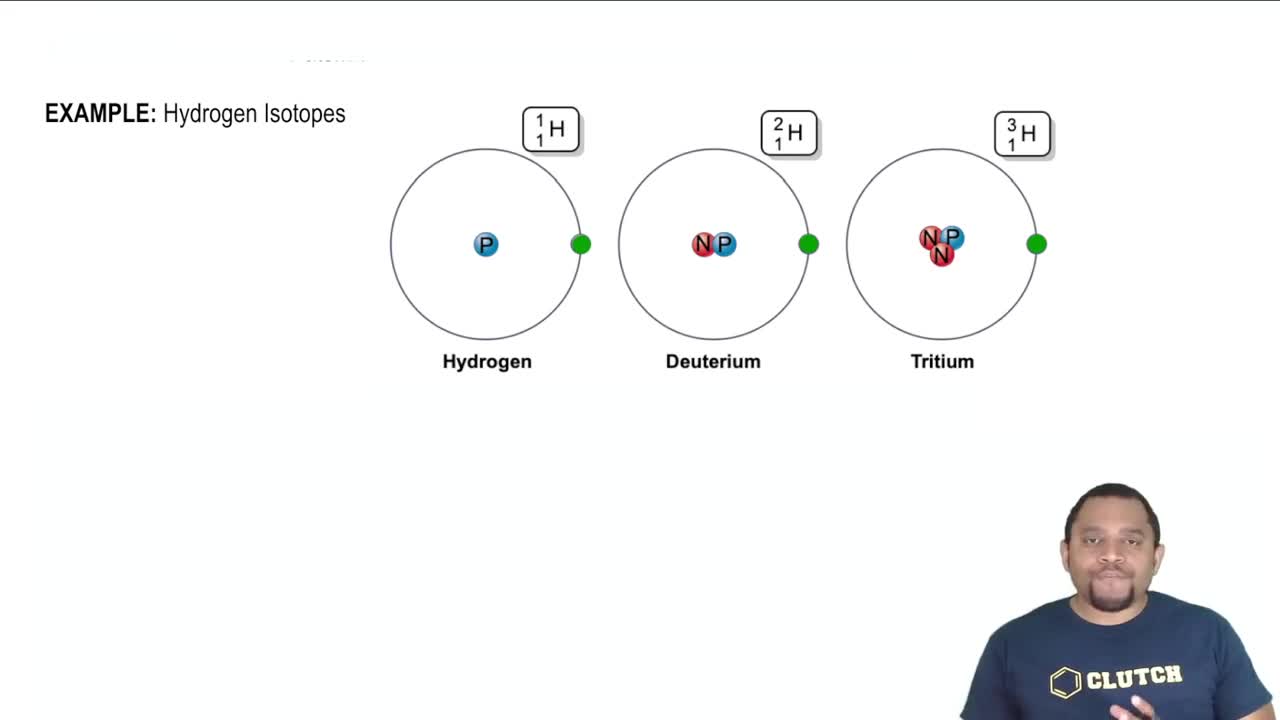
The kinetic isotope effect refers to the change in reaction rate when one atom in a molecule is replaced by one of its isotopes. In this context, the ratio of reaction rates (kH2O/kD2O) indicates how the presence of deuterium affects the hydrolysis of aspirin. A KIE greater than 1 suggests that the bond involving the lighter isotope (H) is broken more easily than that involving the heavier isotope (D), providing insights into the reaction mechanism.
Recommended video:
Guided course
03:06
Understanding the hydrogen isotopes.

Catalysis

Catalysis is the process by which the rate of a chemical reaction is increased by the presence of a catalyst, which is not consumed in the reaction. In the case of the hydrolysis of aspirin, the ortho-carboxyl substituent may stabilize the transition state or lower the activation energy, thus facilitating the breaking of the O-H bond. Understanding the type of catalysis (acid-base, covalent, etc.) is crucial for interpreting the KIE results.
Recommended video:
2:31
Nucleophilic Catalysis Concept 1

O-H vs. O-D Bond Strength

The strength of O-H bonds is generally weaker than that of O-D bonds due to the difference in mass and bond length. This difference is significant in reactions involving proton transfer or bond cleavage. The hint in the question emphasizes that it is easier to break an O-H bond than an O-D bond, which is critical for understanding why the KIE of 2.2 suggests a specific catalytic mechanism influenced by the ortho-carboxyl group.
Recommended video:
Guided course
02:48
O,P-positions vs. Meta-Positions