
Chlorocyclohexane reacts with sodium cyanide (NaCN) in ethanol to give cyanocyclohexane. The rate of formation of cyanocyclohexane increases when a small amount of sodium iodide is added to the solution. Explain this acceleration in the rate.
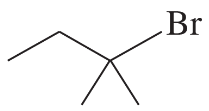
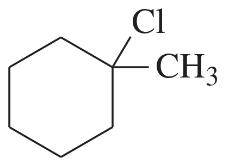
Give the substitution products expected from solvolysis of each compound by heating in ethanol.
(a) 
(b) 
Verified step by step guidance
Verified video answer for a similar problem:
Key Concepts
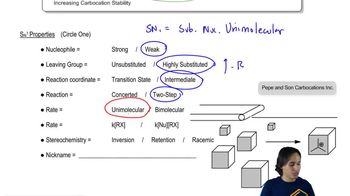
Solvolysis
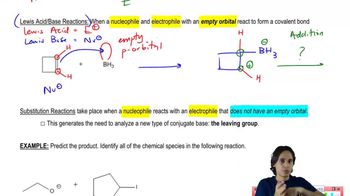
Nucleophilic Substitution Mechanisms
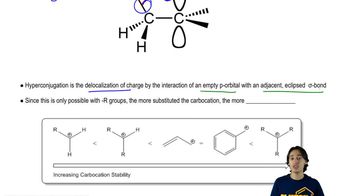
Carbocation Stability
When tert-butyl bromide is heated with an equal amount of ethanol in an inert solvent, one of the products is ethyl tert-butyl ether.
a. What happens to the reaction rate if the concentration of ethanol is doubled?
Allylic halides have the structure
a. Show how the first-order ionization of an allylic halide leads to a resonance-stabilized cation.
Give the substitution products expected from solvolysis of each compound by heating in ethanol.
(c)
(d)
When tert-butyl bromide is heated with an equal amount of ethanol in an inert solvent, one of the products is ethyl tert-butyl ether.
b. What happens to the rate if the concentration of tert-butyl bromide is tripled and the concentration of ethanol is doubled?
c. What happens to the rate if the temperature is raised?
Allylic halides have the structure
b. Draw the resonance structures of the allylic cations formed by ionization of the following halides.
(i)
(ii)
