Ch. 18 - Ketones and Aldehydes
Wade - Organic Chemistry 9th Edition
Wade9th EditionOrganic ChemistryISBN: 9780135213728Not the one you use?Change textbook
Chapter 18, Problem 63

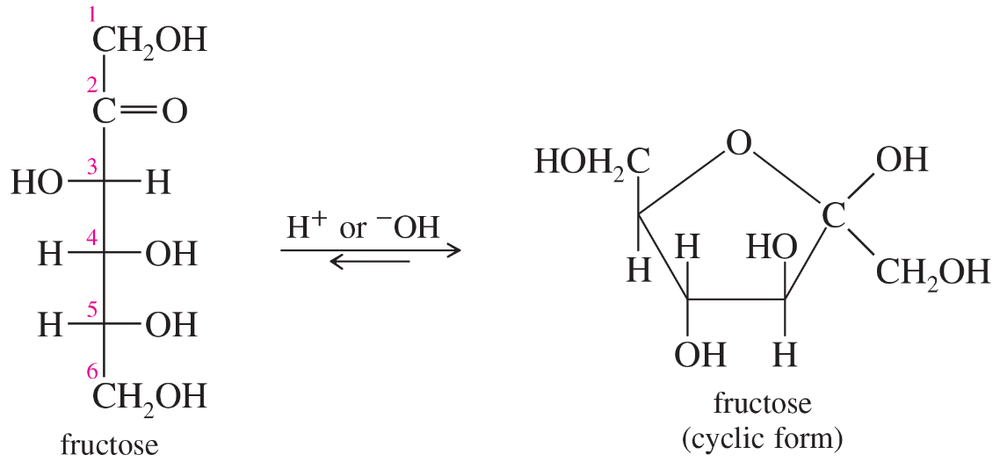
Two structures of the sugar fructose are shown next. The cyclic structure predominates in aqueous solution.

(a) Number the carbon atoms in the cyclic structure. What is the functional group at C2 in the cyclic form?
(b) Propose a mechanism for the cyclization, assuming a trace of acid is present.

Verified step by step guidance
1
Step 1: Number the carbon atoms in the cyclic structure of fructose. Start with the anomeric carbon (the carbon attached to two oxygen atoms) as C1, and proceed sequentially around the ring to number the remaining carbons.
Step 2: Identify the functional group at C2 in the cyclic form. In the cyclic structure of fructose, C2 is part of a hemiketal functional group, which forms when a ketone reacts with an alcohol group within the same molecule.
Step 3: To propose a mechanism for the cyclization, recognize that fructose contains a ketone group at C2 and hydroxyl groups on other carbons. In the presence of a trace of acid, the ketone group at C2 becomes protonated, making it more electrophilic.
Step 4: A nucleophilic attack occurs when the hydroxyl group on C5 attacks the electrophilic carbon of the protonated ketone at C2. This forms a new C-O bond, creating a six-membered ring (a hemiketal).
Step 5: The final step involves deprotonation of the oxygen atom that participated in the nucleophilic attack, stabilizing the cyclic structure. This results in the formation of the predominant cyclic form of fructose in aqueous solution.

Verified video answer for a similar problem:

This video solution was recommended by our tutors as helpful for the problem above.
Video duration:
7m
Was this helpful?

Key Concepts

Here are the essential concepts you must grasp in order to answer the question correctly.

Cyclic Structures of Sugars

Cyclic structures of sugars, such as fructose, are formed when the carbonyl group reacts with a hydroxyl group within the same molecule. This intramolecular reaction leads to the formation of a ring, which is more stable in aqueous solutions. Understanding the specific carbon atoms involved in this cyclization is crucial for identifying functional groups and their positions.
Recommended video:
Guided course
02:21
Reducing Sugars

Functional Groups in Sugars

Functional groups are specific groups of atoms within molecules that are responsible for the characteristic chemical reactions of those molecules. In the case of fructose, the functional group at C2 in its cyclic form is a hydroxyl group (-OH), which plays a significant role in the sugar's reactivity and properties. Identifying functional groups is essential for understanding the behavior of organic compounds.
Recommended video:
Guided course
02:36
Identifying Functional Groups

Acid-Catalyzed Cyclization Mechanism

The cyclization of sugars like fructose can be catalyzed by acids, which protonate the carbonyl oxygen, increasing its electrophilicity. This makes the carbonyl carbon more susceptible to nucleophilic attack by a hydroxyl group, leading to ring formation. Understanding this mechanism is vital for predicting the behavior of sugars in acidic conditions and for grasping broader concepts in organic reaction mechanisms.
Recommended video:
Guided course
06:34
Acid-catalyzed hydration mechanism
Related Practice
Textbook Question

Hydration of alkynes (via oxymercuration) gives good yields of single compounds only with symmetrical or terminal alkynes. Show what the products would be from hydration of each compound.

a. hex-3-yne

1
views

Textbook Question

Hydration of alkynes (via oxymercuration) gives good yields of single compounds only with symmetrical or terminal alkynes. Show what the products would be from hydration of each compound.

c. hex-1-yne

1
views
Textbook Question

There are three dioxane isomers: 1,2-dioxane, 1,3-dioxane, and 1,4-dioxane. One of these acts like an ether and is an excellent solvent for Grignard reactions. Another one is potentially explosive when heated. The third one quickly hydrolyzes in dilute acid. Propose a mechanism for the acid hydrolysis of the third isomer.

1
views
Textbook Question

Two structures for the sugar glucose are shown on page 914. Interconversion of the open-chain and cyclic hemiacetal forms is catalyzed by either acid or base.

(b) The cyclic hemiacetal is more stable than the open-chain form, so very little of the open-chain form is present at equilibrium. Will an aqueous solution of glucose reduce Tollens reagent and give a positive Tollens test? Explain.

1
views
Textbook Question

Hydration of alkynes (via oxymercuration) gives good yields of single compounds only with symmetrical or terminal alkynes. Show what the products would be from hydration of each compound.

b. hex-2-yne

1
views
Textbook Question

Two structures for the sugar glucose are shown on page 914. Interconversion of the open-chain and cyclic hemiacetal forms is catalyzed by either acid or base.

(a) Propose a mechanism for the cyclization, assuming a trace of acid is present.