
Ch. 18 - Ketones and Aldehydes
Wade - Organic Chemistry 9th Edition
Wade9th EditionOrganic ChemistryISBN: 9780135213728Not the one you use?Change textbook
Chapter 18, Problem 61b

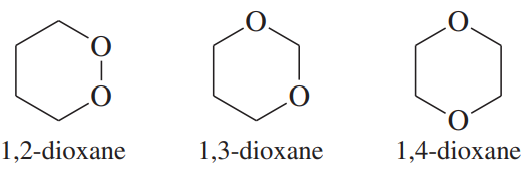
There are three dioxane isomers: 1,2-dioxane, 1,3-dioxane, and 1,4-dioxane. One of these acts like an ether and is an excellent solvent for Grignard reactions. Another one is potentially explosive when heated. The third one quickly hydrolyzes in dilute acid. Propose a mechanism for the acid hydrolysis of the third isomer.
Three dioxane isomers: 1,2-dioxane, 1,3-dioxane, and 1,4-dioxane, with structural formulas labeled.

Verified step by step guidance
1
Identify the structure of the three dioxane isomers: 1,2-dioxane, 1,3-dioxane, and 1,4-dioxane. These are cyclic ethers with two oxygen atoms in the ring. The position of the oxygen atoms in the ring will affect their chemical properties.
Determine which isomer is likely to undergo acid hydrolysis. Acid hydrolysis typically involves the cleavage of ether bonds, and the isomer with oxygen atoms in adjacent positions (1,2-dioxane) is more prone to this reaction due to the strain and reactivity of the ring.
Propose the mechanism for the acid hydrolysis of 1,2-dioxane. The first step involves protonation of one of the oxygen atoms by the acid, increasing the electrophilicity of the carbon atoms adjacent to the oxygen.
Following protonation, the ring opens as the bond between the protonated oxygen and the adjacent carbon breaks, forming a carbocation intermediate. This step is facilitated by the strain in the 1,2-dioxane ring.
Finally, water acts as a nucleophile, attacking the carbocation and leading to the formation of a diol. This completes the hydrolysis process, resulting in the cleavage of the ether bond and formation of two alcohol groups.

Verified video answer for a similar problem:

This video solution was recommended by our tutors as helpful for the problem above.
Video duration:
5m
Was this helpful?

Key Concepts

Here are the essential concepts you must grasp in order to answer the question correctly.

Dioxane Isomers

Dioxane isomers refer to the structural variations of dioxane, which is a six-membered cyclic ether containing two oxygen atoms. The isomers 1,2-dioxane, 1,3-dioxane, and 1,4-dioxane differ in the positions of the oxygen atoms within the ring. These structural differences significantly influence their chemical properties, including reactivity and solubility, which are crucial for understanding their behavior in reactions such as hydrolysis.
Recommended video:
Guided course
01:10
What is a constitutional isomer?

Grignard Reactions

Grignard reactions involve the use of Grignard reagents, which are organomagnesium compounds that react with electrophiles to form carbon-carbon bonds. These reactions are highly sensitive to moisture and require anhydrous conditions, often utilizing ethers as solvents. Understanding the role of solvents in Grignard reactions is essential, as the choice of solvent can affect the reaction's efficiency and the stability of the Grignard reagent.
Recommended video:
Guided course
02:12
Carbonation of Grignard Reagents

Acid Hydrolysis Mechanism

Acid hydrolysis is a chemical reaction where a compound reacts with water in the presence of an acid, leading to the breakdown of the compound. In the case of dioxane isomers, the mechanism typically involves protonation of the ether oxygen, followed by nucleophilic attack by water, resulting in the cleavage of the C-O bond. This process is important for understanding the stability and reactivity of the isomers under acidic conditions, particularly for the isomer that hydrolyzes rapidly.
Recommended video:
0:55
Hydrolysis of Nucleosides Concept 1
Related Practice
Textbook Question

There are three dioxane isomers: 1,2-dioxane, 1,3-dioxane, and 1,4-dioxane. One of these acts like an ether and is an excellent solvent for Grignard reactions. Another one is potentially explosive when heated. The third one quickly hydrolyzes in dilute acid. Show which isomer acts like a simple ether, and then explain why one of them is potentially explosive.

1
views
Textbook Question

Two structures for the sugar glucose are shown on page 914. Interconversion of the open-chain and cyclic hemiacetal forms is catalyzed by either acid or base.

(b) The cyclic hemiacetal is more stable than the open-chain form, so very little of the open-chain form is present at equilibrium. Will an aqueous solution of glucose reduce Tollens reagent and give a positive Tollens test? Explain.

1
views
Textbook Question

Two structures of the sugar fructose are shown next. The cyclic structure predominates in aqueous solution.

(a) Number the carbon atoms in the cyclic structure. What is the functional group at C2 in the cyclic form?

(b) Propose a mechanism for the cyclization, assuming a trace of acid is present.

1
views
Textbook Question

Show how you would accomplish the following syntheses.

(c) benzene → p-methoxybenzaldehyde

2
views
Textbook Question

Show how you would accomplish the following syntheses.

(d)

1
views
Textbook Question

Two structures for the sugar glucose are shown on page 914. Interconversion of the open-chain and cyclic hemiacetal forms is catalyzed by either acid or base.

(a) Propose a mechanism for the cyclization, assuming a trace of acid is present.