Ch. 2 - Acids and Bases; Functional Groups
Wade - Organic Chemistry 9th Edition
Wade9th EditionOrganic ChemistryISBN: 9780135213728Not the one you use?Change textbook
Chapter 2, Problem 43a,b

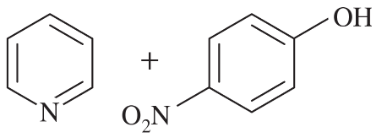
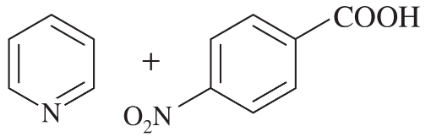
Consider the following proposed Brønsted–Lowry acid–base reactions. In each case, draw the products of a transfer of the most acidic proton on the acid to the most basic site on the base. Use Appendix 4 to find or estimate the pKa values for the acids and the pKb values for the bases. Then determine which side of the reaction is favored, either reactants or products.
(a)
(b)

Verified step by step guidance
1
Identify the acids and bases in each reaction. In reaction (a), 4-chlorophenol is the acid and 3-methylpyridine is the base. In reaction (b), 4-chlorobenzoic acid is the acid and 3-methylpyridine is the base.
Determine the most acidic proton in each acid. For 4-chlorophenol, the most acidic proton is the hydrogen on the hydroxyl group (OH). For 4-chlorobenzoic acid, the most acidic proton is the hydrogen on the carboxylic acid group (COOH).
Identify the most basic site on the base, 3-methylpyridine. The nitrogen atom in the pyridine ring is the most basic site due to its lone pair of electrons.
Draw the products of the proton transfer. In reaction (a), the proton from the hydroxyl group of 4-chlorophenol is transferred to the nitrogen of 3-methylpyridine, forming 3-methylpyridinium ion and 4-chlorophenoxide ion. In reaction (b), the proton from the carboxylic acid group of 4-chlorobenzoic acid is transferred to the nitrogen of 3-methylpyridine, forming 3-methylpyridinium ion and 4-chlorobenzoate ion.
Compare the pKa values of the acids and the conjugate acids to determine the direction of the equilibrium. For reaction (a), compare the pKa of 4-chlorophenol (9.4) with the pKa of 3-methylpyridinium ion (5.6). For reaction (b), compare the pKa of 4-chlorobenzoic acid (3.98) with the pKa of 3-methylpyridinium ion (5.6). The side with the weaker acid (higher pKa) is favored.

Verified video answer for a similar problem:

This video solution was recommended by our tutors as helpful for the problem above.
Video duration:
5m
Was this helpful?

Key Concepts

Here are the essential concepts you must grasp in order to answer the question correctly.

Brønsted–Lowry Acid-Base Theory

The Brønsted–Lowry theory defines acids as proton donors and bases as proton acceptors. In the context of the question, identifying the most acidic proton on the acid and the most basic site on the base is crucial for predicting the products of the reaction. This theory helps in understanding the transfer of protons between reactants, which is fundamental in organic chemistry.
Recommended video:
Guided course
00:54
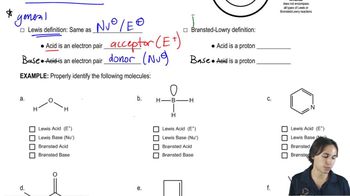
The Bronsted-Lowry definition of acids and bases.

pKa and pKb Values

pKa and pKb values are quantitative measures of the strength of acids and bases, respectively. The pKa indicates the acidity of a compound, while pKb indicates the basicity. In the question, these values are essential for determining the favorability of the reaction; the side with the lower pKa (stronger acid) and higher pKb (weaker base) will be favored in equilibrium.
Recommended video:
Guided course
07:45
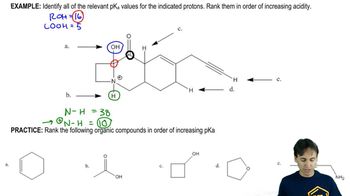
Identifying pKa values

Equilibrium and Reaction Favorability

In chemical reactions, equilibrium refers to the state where the rates of the forward and reverse reactions are equal. The favorability of a reaction can be assessed by comparing the strengths of the acids and bases involved. If the products are more stable (weaker acids and bases) than the reactants, the reaction will favor the formation of products, which is a key consideration in the analysis of the proposed reactions.
Recommended video:
Guided course
04:00
Determining Acid/Base Equilibrium