Ch. 2 - Acids and Bases; Functional Groups
Wade - Organic Chemistry 9th Edition
Wade9th EditionOrganic ChemistryISBN: 9780135213728Not the one you use?Change textbook
Chapter 2, Problem 44

Compare the relative acidity of 1-molar aqueous solutions of the following acids.

Verified step by step guidance
1
Identify the concept of acidity in terms of pKa values: The lower the pKa value, the stronger the acid.
List the given acids along with their pKa values: NH4Cl (pKa=9.26), CH3COOH (pKa=4.74), BrCH2COOH (pKa=2.9), F3CCOOH (pKa=0.2), H2SO4 (pKa=-5), HCl (pKa=-7), HBr (pKa=-9).
Arrange the acids in order of increasing acidity based on their pKa values. Start with the highest pKa value (weakest acid) and end with the lowest pKa value (strongest acid).
Compare the acids: NH4Cl is the weakest acid with the highest pKa, while HBr is the strongest acid with the lowest pKa.
Conclude the comparison by stating that the order of acidity from weakest to strongest is: NH4Cl, CH3COOH, BrCH2COOH, F3CCOOH, H2SO4, HCl, HBr.

Verified video answer for a similar problem:

This video solution was recommended by our tutors as helpful for the problem above.
Video duration:
3m
Was this helpful?

Key Concepts

Here are the essential concepts you must grasp in order to answer the question correctly.

pKa and Acidity

The pKa value is a measure of the strength of an acid in solution. It represents the negative logarithm of the acid dissociation constant (Ka). A lower pKa value indicates a stronger acid, as it implies a greater tendency to donate protons. In comparing acids, the one with the lowest pKa is the strongest acid.
Recommended video:
Guided course
07:45
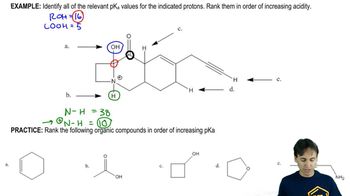
Identifying pKa values

Inductive Effect

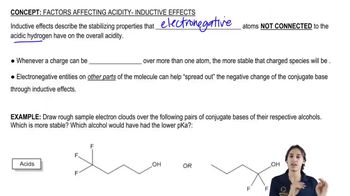
The inductive effect refers to the electron-withdrawing or electron-donating effects exerted by substituents through sigma bonds. Electronegative atoms or groups, such as fluorine in F3CCOOH, can stabilize the negative charge on the conjugate base, increasing the acid's strength. This effect is crucial in understanding why some acids are stronger than others.
Recommended video:
Guided course
01:47
Understanding the Inductive Effect.

Comparing Acid Strengths

To compare the relative acidity of different acids, one must consider both the pKa values and the molecular structure. Acids with lower pKa values are stronger. Additionally, structural factors like the presence of electronegative atoms or resonance stabilization of the conjugate base can significantly influence acidity. For example, HCl and HBr are strong acids due to their very low pKa values and the stability of their conjugate bases.
Recommended video:
Guided course
02:41
Comparing hydrocarbon acidity