Ch. 18 - Ketones and Aldehydes
Wade - Organic Chemistry 9th Edition
Wade9th EditionOrganic ChemistryISBN: 9780135213728Not the one you use?Change textbook
Chapter 18, Problem 68b

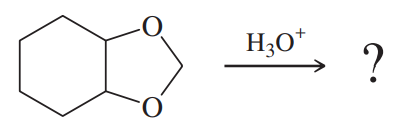
One of these reacts with dilute aqueous acid and the other does not. Give a mechanism for the one that reacts, and show why this mechanism does not work for the other one.
(b) Chemical structure showing two carbonyl groups, one reacting with H3O+ and the other not, with a question mark indicating inquiry.

Verified step by step guidance
1
Identify the functional groups present in both compounds. Look for groups that are known to react with dilute aqueous acid, such as esters, amides, or epoxides.
Determine the reactivity of each functional group with dilute aqueous acid. For example, esters can undergo hydrolysis in the presence of acid, while amides are generally more resistant.
For the compound that reacts, propose a mechanism. If it is an ester, the mechanism involves protonation of the carbonyl oxygen, followed by nucleophilic attack by water, leading to the formation of a tetrahedral intermediate.
Explain why the mechanism does not work for the other compound. If the other compound is an amide, discuss the resonance stabilization of the amide bond, which makes it less susceptible to acid-catalyzed hydrolysis.
Illustrate the complete mechanism for the reacting compound, showing each step with curved arrows to indicate electron movement, and highlight the key differences in structure or stability that prevent the reaction in the non-reacting compound.

Verified video answer for a similar problem:

This video solution was recommended by our tutors as helpful for the problem above.
Video duration:
5m
Was this helpful?

Key Concepts

Here are the essential concepts you must grasp in order to answer the question correctly.

Acid-Base Reactions

Acid-base reactions involve the transfer of protons (H+) between reactants. In organic chemistry, understanding how different functional groups interact with acids is crucial. For example, alcohols can react with acids to form alkyl halides through protonation, while other groups, like alkenes, may not undergo the same reaction due to their structural characteristics.
Recommended video:
Guided course
02:49
The Lewis definition of acids and bases.

Reaction Mechanisms

A reaction mechanism outlines the step-by-step process by which reactants transform into products. It includes details about bond breaking and forming, intermediates, and transition states. For the compound that reacts with dilute aqueous acid, the mechanism may involve protonation followed by nucleophilic attack, while the non-reacting compound may lack a suitable site for protonation or nucleophilic attack.
Recommended video:
Guided course
02:16
Heck Reaction Mechanism

Functional Group Reactivity

Different functional groups exhibit varying reactivities based on their electronic and steric properties. For instance, alcohols are generally more reactive towards acids than alkenes due to their ability to form stable carbocations. Understanding the specific functional groups present in the compounds in question is essential to predict their behavior in acid reactions.
Recommended video:
Guided course
02:36
Identifying Functional Groups