The nucleosides that make up DNA have heterocyclic rings linked to deoxyribose by an aminoacetal functional group. Point out the aminoacetal linkages in deoxycytidine and deoxyadenosine.
Ch. 18 - Ketones and Aldehydes
Chapter 18, Problem 70
Show a complete mechanism for this reaction.

Verified step by step guidance1
Step 1: Protonation of the carbonyl group - The reaction begins with the protonation of the oxygen atom in the carbonyl group of the ketone by HCl. This increases the electrophilicity of the carbonyl carbon, making it more susceptible to nucleophilic attack.
Step 2: Nucleophilic attack by the amine - The lone pair of electrons on the nitrogen atom of the amine attacks the electrophilic carbonyl carbon, forming a tetrahedral intermediate. This step involves the formation of a bond between the nitrogen and the carbonyl carbon.
Step 3: Proton transfer - A proton transfer occurs within the intermediate to stabilize the structure. The hydroxyl group formed from the carbonyl oxygen is protonated, making it a good leaving group.
Step 4: Formation of the iminium ion - The hydroxyl group leaves as water, resulting in the formation of an iminium ion. This intermediate is stabilized by resonance.
Step 5: Nucleophilic attack by methanol - Methanol attacks the iminium ion, forming a bond between the oxygen atom of methanol and the carbon atom of the iminium ion. This leads to the formation of the final product, a cyclic aminal, and water as a byproduct.

Verified video answer for a similar problem:
This video solution was recommended by our tutors as helpful for the problem above.
Video duration:
10mWas this helpful?
Key Concepts
Here are the essential concepts you must grasp in order to answer the question correctly.
Reaction Mechanism
A reaction mechanism is a step-by-step description of how a chemical reaction occurs at the molecular level. It outlines the sequence of elementary steps, including bond breaking and formation, and the intermediates formed during the reaction. Understanding the mechanism is crucial for predicting the products and the conditions under which the reaction occurs.
Recommended video:
Guided course
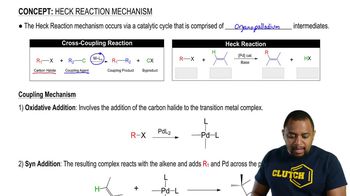
Heck Reaction Mechanism
Nucleophiles and Electrophiles
Nucleophiles are species that donate an electron pair to form a chemical bond, while electrophiles are electron-deficient species that accept an electron pair. Identifying these roles in a reaction is essential for understanding how reactants interact and transform into products. This concept is fundamental in organic chemistry, particularly in substitution and addition reactions.
Recommended video:
Guided course
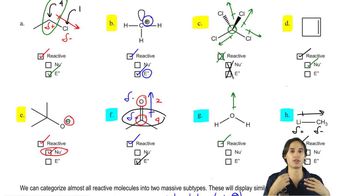
Nucleophile or Electrophile
Catalysis
Catalysis refers to the process of increasing the rate of a chemical reaction by adding a substance called a catalyst, which is not consumed in the reaction. Catalysts work by providing an alternative pathway with a lower activation energy. Understanding the role of catalysts is important for optimizing reaction conditions and improving yields in organic synthesis.
Recommended video:
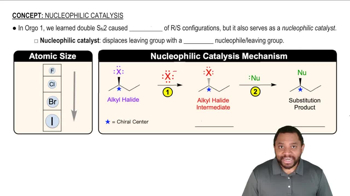
Nucleophilic Catalysis Concept 1
Related Practice
Textbook Question
2
views
Textbook Question
Show a complete mechanism for this equilibrium established in diethyl ether with HCl gas as catalyst.
Textbook Question
One of these reacts with dilute aqueous acid and the other does not. Give a mechanism for the one that reacts, and show why this mechanism does not work for the other one.
(b)
1
views
Textbook Question
One of these reacts with dilute aqueous acid and the other does not. Give a mechanism for the one that reacts, and show why this mechanism does not work for the other one.
(a)
1
views
Textbook Question
Simple aminoacetals hydrolyze quickly and easily in dilute acid. Propose a mechanism for hydrolysis of the following aminoacetal:
1
views