Ch. 20 - Carboxylic Acids
Wade - Organic Chemistry 9th Edition
Wade9th EditionOrganic ChemistryISBN: 9780135213728Not the one you use?Change textbook
Chapter 20, Problem 15b

What monosaccharides are formed in a modified Kiliani–Fischer synthesis starting with each of the following monosaccharides?
b. L-threose

Verified step by step guidance
1
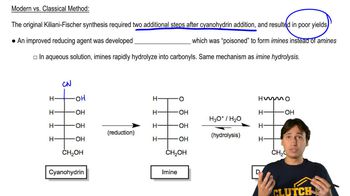
Understand the Kiliani–Fischer synthesis: This reaction is used to lengthen the carbon chain of an aldose by one carbon atom, resulting in the formation of two epimeric aldoses. The process involves cyanohydrin formation, hydrolysis, and reduction of the intermediate to form the new aldoses.
Identify the starting monosaccharide: The problem specifies l-threose, which is a four-carbon aldose (aldotetrose) with the l-configuration. Its structure includes an aldehyde group at C1 and hydroxyl groups at C2 and C3 in the l-configuration.
Determine the intermediate cyanohydrin: In the first step of the Kiliani–Fischer synthesis, l-threose reacts with HCN to form a cyanohydrin intermediate. This adds a new carbon atom to the chain, resulting in a five-carbon compound with a nitrile group at the new C1 position.
Hydrolyze the cyanohydrin: The nitrile group in the cyanohydrin is hydrolyzed to a carboxylic acid group using acidic conditions, forming an aldonic acid. This intermediate is then reduced to an aldehyde group, resulting in two new aldopentoses that are epimers at the newly created chiral center (C2).
Identify the products: The two aldopentoses formed are l-xylose and l-lyxose. These are epimers at C2, differing in the stereochemistry of the hydroxyl group at that position. The l-configuration is retained in both products because the starting monosaccharide was l-threose.

Verified video answer for a similar problem:

This video solution was recommended by our tutors as helpful for the problem above.
Video duration:
4m
Was this helpful?

Key Concepts

Here are the essential concepts you must grasp in order to answer the question correctly.

Kiliani–Fischer Synthesis

The Kiliani–Fischer synthesis is a chemical reaction used to elongate monosaccharides by adding a carbon atom to the chain. This process involves the formation of an aldehyde from a sugar, followed by a reaction with cyanide to create a cyanohydrin, which can then be hydrolyzed to yield a new aldose. This method is particularly useful for synthesizing higher sugars from simpler ones.
Recommended video:
Guided course
03:57
Monosaccharides - Kiliani-Fischer

Monosaccharides

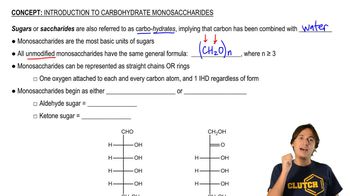
Monosaccharides are the simplest form of carbohydrates, consisting of single sugar units that cannot be hydrolyzed into simpler sugars. Common examples include glucose, fructose, and galactose. They serve as the building blocks for more complex carbohydrates and play crucial roles in energy metabolism and cellular functions.
Recommended video:
Guided course
12:01
Monosaccharide

Stereochemistry of Sugars

Stereochemistry refers to the spatial arrangement of atoms in molecules and is particularly important in organic chemistry for understanding the behavior of sugars. Monosaccharides can exist in different stereoisomeric forms, which can significantly affect their chemical properties and biological functions. For example, l-threose is an aldo-tetrose with specific stereochemical configurations that will influence the products formed during the Kiliani–Fischer synthesis.
Recommended video:
Guided course
08:42
Reducing Sugars
Related Practice
Textbook Question

Show how Fischer esterification might be used to form the following esters. In each case, suggest a method for driving the reaction to completion.

(c) ethyl phenylacetate

6
views

Textbook Question

The mechanism of the Fischer esterification was controversial until 1938, when Irving Roberts and Harold Urey of Columbia University used isotopic labeling to follow the alcohol oxygen atom through the reaction. A catalytic amount of sulfuric acid was added to a mixture of 1 mole of acetic acid and 1 mole of special methanol containing the heavy 18O isotope of oxygen. After a short period, the acid was neutralized to stop the reaction, and the components of the mixture were separated.

(a) Propose a mechanism for this reaction.

(b) Follow the labeled 18O atom through your mechanism, and show where it is found in the products.

1
views
Textbook Question

The Principle of Microscopic Reversibility states that a forward reaction and a reverse reaction taking place under the same conditions (as in an equilibrium) must follow the same reaction pathway in microscopic detail. The reverse of the Fischer esterification is the acid-catalyzed hydrolysis of an ester. Propose a mechanism for the acid-catalyzed hydrolysis of ethyl benzoate, PhCOOCH2CH3.

5
views
Textbook Question

Show how Fischer esterification might be used to form the following esters. In each case, suggest a method for driving the reaction to completion.

(a) methyl salicylate

2
views
Textbook Question

The given was missing some important resonance forms of the intermediates shown in brackets. Complete this mechanism by drawing all the resonance forms of these intermediates. Do your resonance forms help to explain why this reaction occurs under very mild conditions (water with a tiny trace of acid)?

2
views
Textbook Question

A carboxylic acid has two oxygen atoms, each with two nonbonding pairs of electrons.

(a) Draw the resonance forms of a carboxylic acid that is protonated on the hydroxy oxygen atom.

(b) Compare the resonance forms with those given previously for an acid protonated on the carbonyl oxygen atom.

(c) Explain why the carbonyl oxygen atom of a carboxylic acid is more basic than the hydroxy oxygen.

7
views