
Ch.11 - Reactions of Alcohols
Wade - Organic Chemistry 9th Edition
Wade9th EditionOrganic ChemistryISBN: 9780135213728Not the one you use?Change textbook
Chapter 11, Problem 58

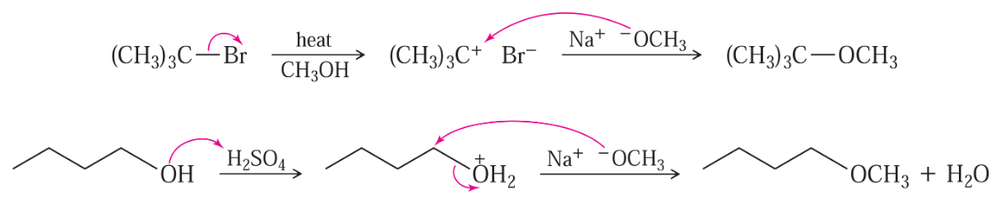
The following pseudo-syntheses (guaranteed not to work) exemplify a common conceptual error.

(a) What is the conceptual error implicit in these syntheses?
(b) Propose syntheses that are more likely to succeed.

Verified step by step guidance
1
Step 1: Analyze the first pseudo-synthesis. The reaction starts with tert-butyl bromide ((CH₃)₃C-Br) and involves heating in methanol (CH₃OH). This leads to the formation of a tert-butyl carbocation ((CH₃)₃C⁺), which is then attacked by methoxide ion (Na⁺-OCH₃). The conceptual error here is that the reaction assumes the carbocation will form and react cleanly without side reactions, but tert-butyl carbocations are prone to rearrangements and elimination reactions, leading to byproducts.
Step 2: Analyze the second pseudo-synthesis. The reaction starts with 1-butanol (CH₃CH₂CH₂CH₂OH) and involves treatment with sulfuric acid (H₂SO₄) to form a carbocation intermediate. This carbocation is then attacked by methoxide ion (Na⁺-OCH₃). The conceptual error here is that primary carbocations (like the one formed from 1-butanol) are highly unstable and unlikely to form under these conditions. Instead, elimination reactions or rearrangements are more likely.
Step 3: Propose a corrected synthesis for the first reaction. Instead of relying on carbocation formation, use an SN2 reaction mechanism. React tert-butyl bromide ((CH₃)₃C-Br) directly with sodium methoxide (Na⁺-OCH₃) in an aprotic solvent like DMSO to avoid carbocation formation and promote nucleophilic substitution.
Step 4: Propose a corrected synthesis for the second reaction. Since primary carbocations are unstable, use a Williamson ether synthesis. React 1-butanol (CH₃CH₂CH₂CH₂OH) with sodium hydride (NaH) to deprotonate the alcohol, forming the alkoxide ion. Then react the alkoxide with methyl bromide (CH₃Br) to form the desired ether (CH₃CH₂CH₂CH₂OCH₃).
Step 5: Summarize the key conceptual errors. The first synthesis incorrectly assumes that tert-butyl carbocations will react cleanly without side reactions, while the second synthesis assumes that primary carbocations can form and react under acidic conditions. Both errors can be corrected by using mechanisms that avoid unstable intermediates, such as SN2 or Williamson ether synthesis.

Verified video answer for a similar problem:

This video solution was recommended by our tutors as helpful for the problem above.
Video duration:
2m
Was this helpful?

Key Concepts

Here are the essential concepts you must grasp in order to answer the question correctly.

Reaction Mechanisms

Understanding reaction mechanisms is crucial in organic chemistry as they describe the step-by-step process by which reactants transform into products. This includes the movement of electrons, the formation and breaking of bonds, and the role of intermediates. A clear grasp of mechanisms helps identify why certain syntheses may fail and how to propose more viable alternatives.
Recommended video:
Guided course
02:16
Heck Reaction Mechanism

Functional Groups

Functional groups are specific groups of atoms within molecules that are responsible for the characteristic chemical reactions of those molecules. Recognizing functional groups is essential for predicting reactivity and understanding how different compounds can be synthesized. Errors in synthesis often arise from overlooking the properties and reactivity of these groups.
Recommended video:
Guided course
02:36
Identifying Functional Groups

Synthesis Strategies

Synthesis strategies involve planning a series of chemical reactions to construct a desired compound from simpler starting materials. Effective strategies consider factors such as yield, selectivity, and the stability of intermediates. Proposing successful syntheses requires knowledge of available reagents, reaction conditions, and the ability to foresee potential pitfalls in the proposed pathways.
Recommended video:
1:16
Synthesis of Amino Acids: Strecker Synthesis Example 1
Related Practice
Textbook Question

The Williamson ether synthesis involves the displacement of an alkyl halide or tosylate by an alkoxide ion. Would the synthesis shown be possible by making a tosylate and displacing it? If so, show the sequence of reactions. If not, explain why not and show an alternative synthesis that would be more likely to work.

2
views
Textbook Question

Two unknowns, X and Y, both having the molecular formula C4H8O, give the following results with four chemical tests. Propose structures for X and Y consistent with this information.

2
views
Textbook Question

Chromic acid oxidation of an alcohol (Section 11-2A) occurs in two steps: formation of the chromate ester, followed by an elimination of H+ and chromium. Which step do you expect to be rate-limiting? Careful kinetic studies have shown that Compound A undergoes chromic acid oxidation over 10 times as fast as Compound B. Explain this large difference in rates.

1
views
Textbook Question

Show how you would synthesize the following compounds. As starting materials, you may use any alcohols containing four or fewer carbon atoms, cyclohexanol, and any necessary solvents and inorganic reagents.

(h)

5
views
Textbook Question

Show how you would synthesize the following compound. As starting materials, you may use any alcohols containing five or fewer carbon atoms and any necessary solvents and inorganic reagents.

4
views
Textbook Question

Show how you would synthesize the following compounds. As starting materials, you may use any alcohols containing four or fewer carbon atoms, cyclohexanol, and any necessary solvents and inorganic reagents.

(g)

1
views