Ch. 11 - Properties and Synthesis of Alkyl Halides: Radical Reactions
Mullins - Organic Chemistry: A Learner Centered Approach 1st Edition
Mullins1st EditionOrganic Chemistry: A Learner Centered ApproachISBN: 9780137566471Not the one you use?Change textbook
Chapter 10, Problem 15

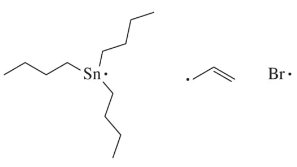
A radical reaction, as it progressed through its propagation steps, involved the following radical species. Suggest which products might form in all possible termination steps (six products are possible).

Verified step by step guidance
1
Identify the radical species involved in the reaction. In the image, we have a tin radical (Sn·) and a bromine radical (Br·), as well as an ethyl radical (·CH2CH3).
Understand that in a radical termination step, two radicals combine to form a stable molecule. This process removes radicals from the reaction mixture.
Consider all possible pairings of the radicals to form stable products. The radicals can pair as follows: Sn· with Br·, Sn· with ·CH2CH3, and Br· with ·CH2CH3.
For each pairing, draw the resulting molecule. For example, when Sn· and Br· combine, they form an organotin bromide compound.
Repeat the process for all possible combinations, ensuring that each radical is paired with every other radical at least once. This will result in six possible termination products.

Verified video answer for a similar problem:

This video solution was recommended by our tutors as helpful for the problem above.
Was this helpful?

Key Concepts

Here are the essential concepts you must grasp in order to answer the question correctly.

Radical Reaction Mechanism

Radical reactions involve species with unpaired electrons, known as radicals. These reactions typically proceed through three stages: initiation, propagation, and termination. In the termination step, radicals combine to form stable products, ceasing the radical chain process. Understanding these stages is crucial for predicting possible products in radical reactions.
Recommended video:
Guided course
12:11
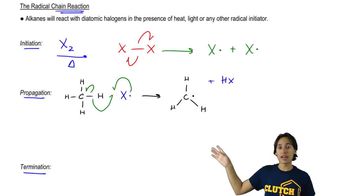
Radical Chain Reaction Mechanism.

Termination Steps in Radical Reactions

Termination steps occur when two radical species combine to form a stable, non-radical product. This step is essential in radical reactions as it determines the final products formed. In the given image, radicals such as Sn· and Br· can combine in various ways, leading to different termination products, which are crucial for understanding the reaction's outcome.
Recommended video:
Guided course
12:11
Radical Chain Reaction Mechanism.

Radical Stability and Reactivity

Radical stability is influenced by factors such as the presence of electron-donating groups and the type of atom bearing the radical. More stable radicals are less reactive, affecting the likelihood of certain termination products. In the image, the stability of Sn· and Br· radicals will guide which combinations are more favorable, impacting the prediction of possible products.
Recommended video:
Guided course
03:43
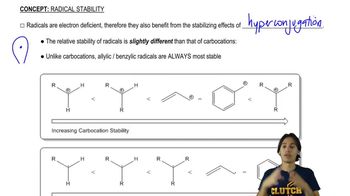
The radical stability trend.