Textbook Question
Based on the stability of the radicals produced, predict which bond in each pair would have the higher bond-dissociation energy.
(a)
8
views

 Mullins 1st EditionCh. 11 - Properties and Synthesis of Alkyl Halides: Radical ReactionsProblem 14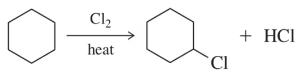
 Verified step by step guidance
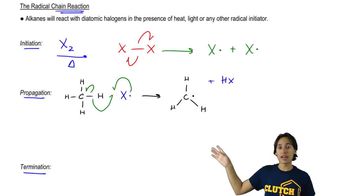
 12:11
12:11
 1:05 1:05
Based on the stability of the radicals produced, predict which bond in each pair would have the higher bond-dissociation energy.
(a)
A radical reaction, as it progressed through its propagation steps, involved the following radical species. Suggest which products might form in all possible termination steps (six products are possible).
Specify the conditions that would allow the synthesis of the 1° and 3° bromoalkanes from the same starting alkene.
Halohydrin formation is a stereospecific reaction. Identify the products of halohydrin formation of the following diastereomeric alkenes to demonstrate this stereospecificity.
The most stable intermediate forms first. Explain this statement by showing a reaction coordinate diagram for the formation of a 3° carbocation over a 2° carbocation in the following alkene addition reaction.
Based on the stability of the radicals produced, predict which bond in each pair would have the higher bond-dissociation energy.
(b)