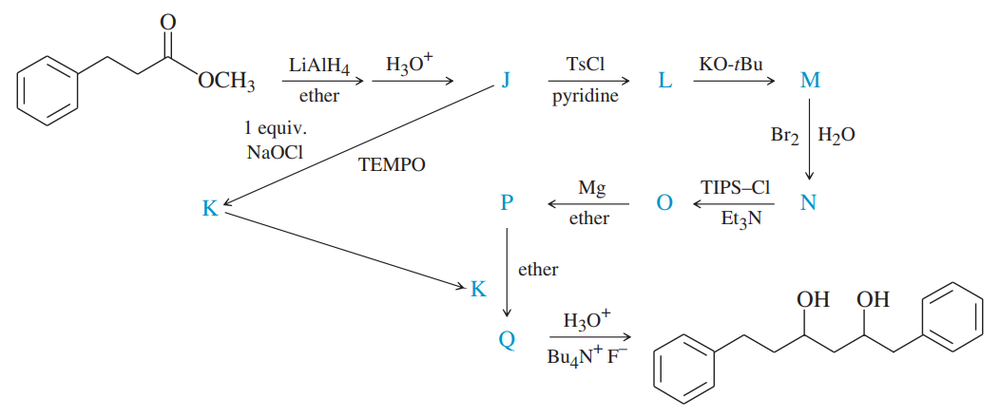
Give the structures of the intermediates represented by letters O, P, and Q in this synthesis.
Verified step by step guidance
1
Step 1: Analyze the starting material and the first reaction. The starting material is an ester (methyl 3-phenylpropanoate). Reaction with LiAlH4 in ether reduces the ester to a primary alcohol. The intermediate J is therefore the corresponding primary alcohol, 3-phenylpropanol.
Step 2: Examine the conversion of J to K. The alcohol (J) is oxidized using NaOCl and TEMPO, which selectively oxidizes primary alcohols to aldehydes. Thus, intermediate K is 3-phenylpropanal.
Step 3: Analyze the reaction of J with TsCl and pyridine. This reaction converts the hydroxyl group of J into a tosylate group, forming intermediate L. Tosylates are good leaving groups, facilitating further reactions.
Step 4: Examine the reaction of L with KO-tBu. This is an elimination reaction where the tosylate group is eliminated, forming an alkene. Intermediate M is therefore 3-phenylpropene.
Step 5: Analyze the reaction of M with Br2 and H2O. This is a bromohydrin formation reaction, where the alkene reacts with bromine in water to form a bromohydrin. Intermediate N is 1-bromo-2-hydroxy-3-phenylpropane.
Verified video answer for a similar problem:
This video solution was recommended by our tutors as helpful for the problem above
Video duration:
9m
Play a video:
0 Comments
Key Concepts
Here are the essential concepts you must grasp in order to answer the question correctly.
Synthesis Pathways
Synthesis pathways illustrate the step-by-step transformation of reactants into products through various intermediates. Understanding these pathways is crucial for identifying the structures of intermediates, as each step often involves specific reagents and conditions that dictate the outcome of the reaction.
Energy Production In Biochemical Pathways Concept 1
Reagents and Their Functions
Different reagents play specific roles in organic reactions, such as reducing agents, oxidizing agents, or catalysts. For instance, LiAlH4 is a strong reducing agent used to convert carbonyl compounds to alcohols, while TsCl is used for activating alcohols for further reactions. Recognizing the function of each reagent helps in predicting the structure of intermediates.
Functional group transformations involve the conversion of one functional group into another, which is a common theme in organic synthesis. For example, the conversion of an alcohol to a carbonyl compound or vice versa is essential for understanding the intermediates in the synthesis pathway. Familiarity with these transformations aids in deducing the structures of intermediates labeled in the synthesis.