Ch. 16 - Reactions of Aldehydes and Ketones • More Reactions of Carboxylic Acid Derivatives
Bruice - Organic Chemistry 8th Edition
Bruice8th EditionOrganic ChemistryISBN: 9780135213711Not the one you use?Change textbook
Chapter 17, Problem 46b

Show how each of the following compounds could be prepared from the given starting material. Each requires a protecting group.
b. Chemical reaction diagram showing the conversion of an alcohol to a protected alcohol using a protecting group.

Verified step by step guidance
1
Step 1: Identify the functional groups in the starting material and the target compound. The starting material contains a hydroxyl group (-OH) and a ketone group (C=O). The target compound has an additional hydroxyl group and a methyl group added to the structure.
Step 2: Recognize the need for a protecting group. The hydroxyl group in the starting material must be protected to prevent unwanted reactions during the transformation of the ketone group.
Step 3: Protect the hydroxyl group. Use a protecting group such as a silyl ether (e.g., TBDMS-Cl) to temporarily mask the hydroxyl group. This ensures that the hydroxyl group does not interfere with subsequent reactions.
Step 4: Perform the addition reaction to introduce the methyl group and the new hydroxyl group. Use a Grignard reagent (e.g., CH3MgBr) to react with the ketone group, forming a tertiary alcohol.
Step 5: Remove the protecting group. After the desired transformation is complete, deprotect the hydroxyl group using a mild acid or fluoride source (e.g., TBAF) to regenerate the original hydroxyl group.

Verified video answer for a similar problem:

This video solution was recommended by our tutors as helpful for the problem above.
Video duration:
7m
Was this helpful?

Key Concepts

Here are the essential concepts you must grasp in order to answer the question correctly.

Protecting Groups

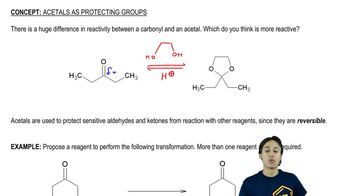
Protecting groups are temporary modifications used in organic synthesis to prevent certain functional groups from reacting during a chemical reaction. They allow chemists to selectively manipulate other parts of a molecule without interference from the protected group. Common protecting groups for alcohols include silyl ethers and acetals, which can be removed later to restore the original functional group.
Recommended video:
Guided course
02:44
Protecting Groups

Synthesis of Alcohols

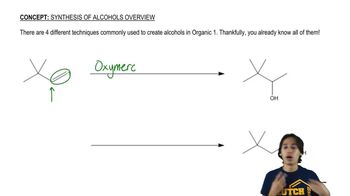
The synthesis of alcohols often involves the reduction of carbonyl compounds or the substitution of halides with nucleophiles. In the context of the question, understanding how to convert a starting material into a desired alcohol product is crucial. This may involve multiple steps, including the use of protecting groups to ensure that the reaction conditions do not affect sensitive functional groups.
Recommended video:
Guided course
02:26
Forming alcohols through Oxymercuration-Reduction.

Reaction Mechanisms

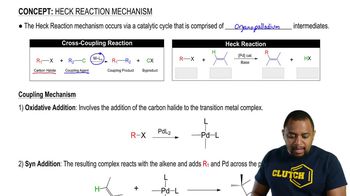
Understanding reaction mechanisms is essential for predicting the outcomes of chemical reactions. Mechanisms describe the step-by-step process by which reactants are converted into products, including the formation and breaking of bonds. In this case, knowing the mechanism of how protecting groups are added and removed, as well as how alcohols are formed, will help in designing the synthesis pathway from the starting material to the target compounds.
Recommended video:
Guided course
02:16
Heck Reaction Mechanism