Ch. 16 - Reactions of Aldehydes and Ketones • More Reactions of Carboxylic Acid Derivatives
Bruice - Organic Chemistry 8th Edition
Bruice8th EditionOrganic ChemistryISBN: 9780135213711Not the one you use?Change textbook
Chapter 17, Problem 46c

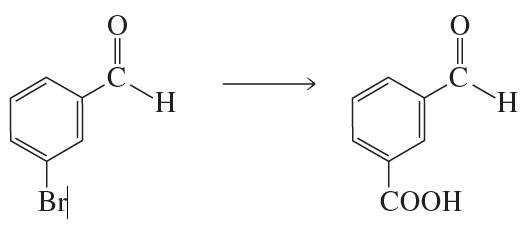
Show how each of the following compounds could be prepared from the given starting material. Each requires a protecting group.
c. Chemical reaction diagram showing the conversion of a brominated aldehyde to a carboxylic acid.

Verified step by step guidance
1
Step 1: Analyze the transformation. The starting material is a brominated aromatic ketone, and the target compound is a carboxylic acid substituted aromatic ketone. This indicates that the bromine group needs to be replaced with a carboxylic acid group.
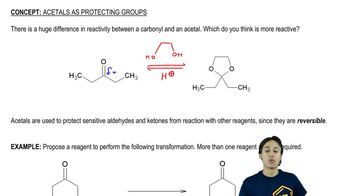
Step 2: Introduce a protecting group for the ketone functionality. Ketones are susceptible to side reactions during certain transformations, so protecting the ketone group is necessary. Use ethylene glycol in the presence of an acid catalyst to form a cyclic ketal protecting group.
Step 3: Perform the carboxylation reaction. Replace the bromine atom with a carboxylic acid group using a Grignard reagent. First, convert the bromine into a magnesium bromide Grignard reagent by reacting with magnesium in dry ether. Then, react the Grignard reagent with carbon dioxide (CO₂) to form the carboxylic acid group.
Step 4: Remove the protecting group. Hydrolyze the cyclic ketal under acidic conditions to regenerate the ketone functionality.
Step 5: Purify the product. Use techniques such as recrystallization or chromatography to isolate the desired carboxylic acid substituted aromatic ketone.

Verified video answer for a similar problem:

This video solution was recommended by our tutors as helpful for the problem above.
Video duration:
8m
Was this helpful?

Key Concepts

Here are the essential concepts you must grasp in order to answer the question correctly.

Protecting Groups

Protecting groups are temporary modifications used in organic synthesis to prevent certain functional groups from reacting during a chemical reaction. They allow for selective reactions to occur on other parts of the molecule without interference. After the desired reaction is completed, the protecting group can be removed to restore the original functional group.
Recommended video:
Guided course
02:44
Protecting Groups

Electrophilic Aromatic Substitution (EAS)

Electrophilic Aromatic Substitution is a fundamental reaction in organic chemistry where an electrophile replaces a hydrogen atom on an aromatic ring. This reaction is crucial for modifying aromatic compounds, such as bromobenzene, to introduce new functional groups. Understanding the mechanism of EAS helps in predicting the outcomes of reactions involving aromatic compounds.
Recommended video:

Carboxylic Acids

Carboxylic acids are organic compounds characterized by the presence of a carboxyl group (-COOH). They are important functional groups in organic chemistry, often involved in various reactions, including oxidation and substitution. The conversion of bromobenzene to benzoic acid illustrates the transformation of an aromatic halide into a carboxylic acid, showcasing the utility of functional group interconversions in synthesis.
Recommended video:
Guided course
04:20
Carboxylic Acids Nomenclature