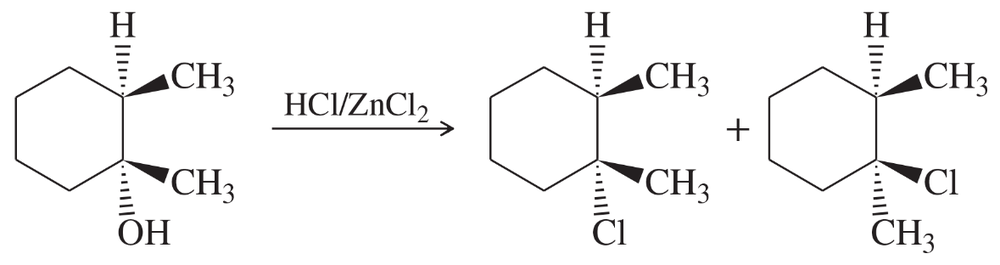
Explain the products observed in the following reaction of an alcohol with the Lucas reagent.
Verified step by step guidance
1
Step 1: Recognize the reaction type. The reaction involves an alcohol reacting with Lucas reagent (HCl/ZnCl₂). Lucas reagent is used to test the reactivity of alcohols and convert them into alkyl chlorides via an SN1 or SN2 mechanism depending on the alcohol type.
Step 2: Analyze the structure of the alcohol. The alcohol in the reaction is a secondary alcohol, as the hydroxyl group (-OH) is attached to a carbon atom that is bonded to two other carbon atoms. Secondary alcohols typically undergo substitution reactions via the SN1 mechanism in the presence of Lucas reagent.
Step 3: Understand the mechanism. In the SN1 mechanism, the reaction proceeds through the formation of a carbocation intermediate. The hydroxyl group is protonated by HCl, forming water as a leaving group. This leads to the generation of a carbocation intermediate.
Step 4: Consider carbocation stability. The carbocation formed is stabilized by hyperconjugation and inductive effects from the surrounding alkyl groups. This stability allows the reaction to proceed efficiently.
Step 5: Formation of products. The chloride ion (Cl⁻) from HCl attacks the carbocation, leading to the formation of two stereoisomeric alkyl chlorides due to the planar nature of the carbocation intermediate. These products are observed as the final result of the reaction.
Verified video answer for a similar problem:
This video solution was recommended by our tutors as helpful for the problem above
Video duration:
6m
Play a video:
0 Comments
Key Concepts
Here are the essential concepts you must grasp in order to answer the question correctly.
Lucas Reagent
The Lucas reagent is a solution of hydrochloric acid (HCl) and zinc chloride (ZnCl2) used to convert alcohols into alkyl chlorides. It is particularly effective for distinguishing between primary, secondary, and tertiary alcohols based on their reactivity. Tertiary alcohols react rapidly, while primary alcohols react slowly or not at all, allowing for the identification of alcohol types.
Alcohols can be classified as primary, secondary, or tertiary based on the number of carbon atoms attached to the carbon bearing the hydroxyl (-OH) group. This classification affects their reactivity with reagents like the Lucas reagent. Tertiary alcohols undergo rapid substitution reactions, while primary alcohols require stronger conditions to react, influencing the products formed in the reaction.
A substitution reaction involves the replacement of one functional group in a molecule with another. In the context of the reaction with the Lucas reagent, the hydroxyl group of the alcohol is replaced by a chlorine atom, resulting in the formation of alkyl chlorides. This type of reaction is fundamental in organic chemistry, as it allows for the transformation of functional groups and the synthesis of various compounds.