Ch. 10 - Reactions of Alcohols, Ethers, Epoxides, Amines, and Sulfur-Containing Compounds
Bruice - Organic Chemistry 8th Edition
Bruice8th EditionOrganic ChemistryISBN: 9780135213711Not the one you use?Change textbook
Chapter 11, Problem 91c

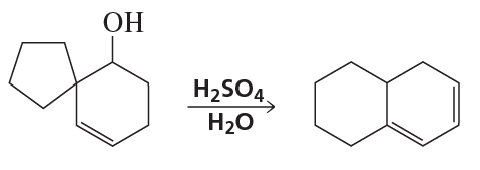
Propose a mechanism for each of the following reactions:
c. Chemical reaction diagram showing the conversion of an alcohol to an ether using sulfuric acid and water.

Verified step by step guidance
1
Step 1: Protonation of the alcohol group - The reaction begins with the protonation of the hydroxyl (-OH) group by sulfuric acid (H₂SO₄). This converts the alcohol into a better leaving group, forming a positively charged oxonium ion.
Step 2: Formation of a carbocation - The oxonium ion undergoes loss of water (H₂O), resulting in the formation of a carbocation at the carbon where the hydroxyl group was originally attached. This carbocation is stabilized by resonance with the adjacent double bond.
Step 3: Rearrangement of the carbocation - A hydride shift or alkyl shift occurs to form a more stable carbocation. In this case, the rearrangement leads to a tertiary carbocation, which is more stable due to hyperconjugation and inductive effects.
Step 4: Cyclization - The newly formed carbocation undergoes an intramolecular electrophilic attack by the double bond in the molecule, leading to the formation of a new ring structure. This step forms the fused bicyclic system observed in the product.
Step 5: Deprotonation - Finally, a proton is removed from the positively charged intermediate by water or another base present in the reaction mixture, restoring the double bond and completing the formation of the aromatic bicyclic product.

Verified video answer for a similar problem:

This video solution was recommended by our tutors as helpful for the problem above.
Video duration:
6m
Was this helpful?

Key Concepts

Here are the essential concepts you must grasp in order to answer the question correctly.

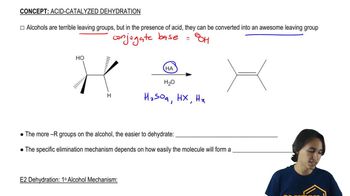
Acid-Catalyzed Dehydration

Acid-catalyzed dehydration is a reaction where an alcohol is converted into an alkene through the removal of a water molecule, facilitated by an acid such as sulfuric acid (H2SO4). The acid protonates the hydroxyl group, making it a better leaving group, which then departs as water, leading to the formation of a carbocation that can rearrange or lose a proton to form a double bond.
Recommended video:
Guided course
06:01
General features of acid-catalyzed dehydration.

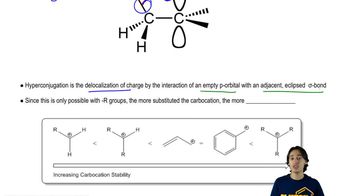
Carbocation Stability

Carbocation stability is crucial in organic reactions, as more stable carbocations are formed preferentially. Stability is influenced by factors such as the degree of substitution (tertiary > secondary > primary) and resonance. In the mechanism of dehydration, the formation of a more stable carbocation intermediate can lead to a more favorable reaction pathway and product distribution.
Recommended video:
Guided course
05:58
Determining Carbocation Stability

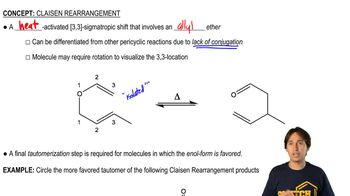
Rearrangement of Intermediates

Rearrangement of intermediates refers to the process where carbocations can shift their structure to form more stable configurations during a reaction. This can involve hydride or alkyl shifts, which can lead to the formation of different products. Understanding this concept is essential for predicting the outcome of reactions involving carbocations, such as in the dehydration of alcohols.
Recommended video:
Guided course
06:08
Definition of Claisen Rearrangement