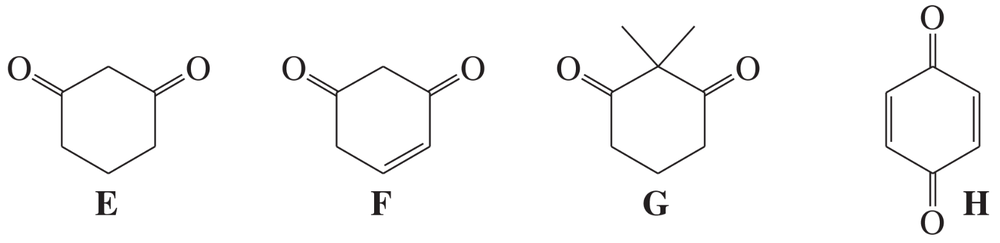
Rank these compounds in order of increasing enol content. In each case, draw the most stable enol.
Verified step by step guidance
1
Step 1: Understand the concept of enol content. Enol content refers to the proportion of a compound that exists in the enol form (a structure with a hydroxyl group directly attached to a double-bonded carbon). The stability of the enol form is influenced by factors such as hydrogen bonding, conjugation, and steric effects.
Step 2: Analyze compound E. Compound E has two ketone groups. The enol form can be stabilized by intramolecular hydrogen bonding between the hydroxyl group and the adjacent ketone oxygen. Draw the most stable enol form by converting one of the ketone groups into an enol.
Step 3: Analyze compound F. Compound F has a conjugated double bond adjacent to one of the ketone groups. The enol form can be stabilized by resonance between the hydroxyl group and the conjugated system. Draw the most stable enol form by converting the ketone group adjacent to the double bond into an enol.
Step 4: Analyze compound G. Compound G has two ketone groups and additional steric hindrance due to the methyl groups. The steric hindrance reduces the stability of the enol form. Draw the most stable enol form by converting one of the ketone groups into an enol, considering steric effects.
Step 5: Analyze compound H. Compound H has two ketone groups in a conjugated cyclic system. The enol form can be highly stabilized by resonance within the conjugated system. Draw the most stable enol form by converting one of the ketone groups into an enol, ensuring resonance stabilization. Rank the compounds in order of increasing enol content based on the stability of their enol forms.
Verified video answer for a similar problem:
This video solution was recommended by our tutors as helpful for the problem above
Video duration:
14m
Play a video:
0 Comments
Key Concepts
Here are the essential concepts you must grasp in order to answer the question correctly.
Enol Tautomerism
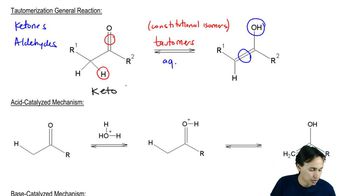
Enol tautomerism is a chemical equilibrium between a keto form (a carbonyl compound) and its corresponding enol form (an alcohol with a double bond). The stability of each form depends on factors such as sterics, electronics, and hydrogen bonding. Understanding this concept is crucial for predicting the relative amounts of enol and keto forms in a compound.
The stability of enols can be influenced by factors such as substitution patterns, resonance, and steric hindrance. Enols that can participate in intramolecular hydrogen bonding or have electron-withdrawing groups nearby tend to be more stable. Recognizing these factors helps in ranking compounds based on their enol content.
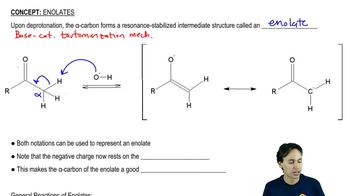
Keto-enol equilibrium refers to the dynamic balance between the keto and enol forms of a compound. The position of this equilibrium can be affected by temperature, solvent, and the presence of catalysts. Understanding this equilibrium is essential for determining which compounds will have higher enol content and for drawing the most stable enol structures.