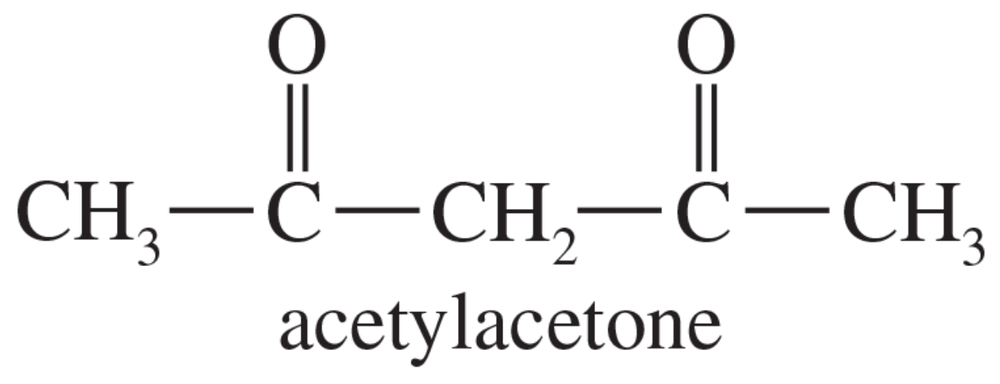
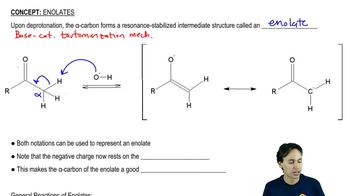
Pentane-2,4-dione (acetylacetone) exists as a tautomeric mixture of 8% keto and 92% enol forms. Draw the stable enol tautomer, and explain its unusual stability.
Verified step by step guidance
1
Understand the concept of tautomerism: Tautomerism is a chemical equilibrium between two structural isomers (tautomers) that differ in the position of a proton and the double bond. In this case, pentane-2,4-dione (acetylacetone) exists in keto and enol forms.
Draw the keto form of pentane-2,4-dione: The keto form has two carbonyl groups (C=O) at positions 2 and 4 of the pentane chain. Represent this structure as CH3-CO-CH2-CO-CH3.
Draw the enol form of pentane-2,4-dione: The enol form is created by transferring a proton from the central methylene group (-CH2-) to one of the oxygen atoms of the carbonyl group, forming a hydroxyl group (-OH) and a double bond between the central carbon and the adjacent carbon. Represent this structure as CH3-C(OH)=CH-C(O)-CH3.
Explain the unusual stability of the enol form: The enol form of acetylacetone is stabilized by intramolecular hydrogen bonding. The hydroxyl group (-OH) forms a hydrogen bond with the oxygen atom of the adjacent carbonyl group, creating a six-membered ring structure. This hydrogen bonding significantly lowers the energy of the enol form, making it more stable than expected.
Discuss the dominance of the enol form: Due to the stabilization provided by intramolecular hydrogen bonding, the enol form is the predominant tautomer in the equilibrium mixture, accounting for 92% of the total, compared to only 8% for the keto form.
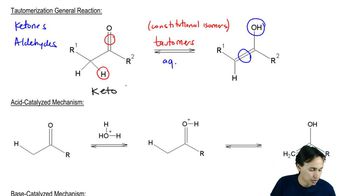
Verified video answer for a similar problem:
This video solution was recommended by our tutors as helpful for the problem above
Play a video:
0 Comments
Key Concepts
Here are the essential concepts you must grasp in order to answer the question correctly.
Tautomerism
Tautomerism is a chemical phenomenon where two or more structural isomers, known as tautomers, exist in dynamic equilibrium. In the case of pentane-2,4-dione, the keto form (with a carbonyl group) and the enol form (with an alcohol group) are tautomers. The equilibrium between these forms can shift based on conditions such as pH and solvent, influencing the stability of each tautomer.
The enol form of a compound can exhibit unusual stability due to intramolecular hydrogen bonding and resonance stabilization. In pentane-2,4-dione, the enol form benefits from a hydrogen bond between the hydroxyl group and the carbonyl oxygen, which stabilizes the structure. This intramolecular interaction lowers the energy of the enol form, making it more favorable despite being less common than the keto form.
Keto-enol equilibrium refers to the balance between the keto and enol forms of a compound. Factors such as solvent effects, temperature, and the presence of substituents can influence the position of this equilibrium. In pentane-2,4-dione, the predominance of the enol form (92%) over the keto form (8%) indicates that the enol is significantly stabilized, highlighting the importance of molecular interactions in determining the stability of tautomers.