
Ch. 15 - Conjugated Systems, Orbital Symmetry, and Ultraviolet Spectroscopy
Wade - Organic Chemistry 9th Edition
Wade9th EditionOrganic ChemistryISBN: 9780135213728Not the one you use?Change textbook
Chapter 15, Problem 37a

The pentadienyl radical, H2C=CH–CH=CH–CH2, has its unpaired electron delocalized over three carbon atoms.
a. Use resonance forms to show which three carbon atoms bear the unpaired electron.

Verified step by step guidance
1
Step 1: Begin by identifying the structure of the pentadienyl radical, H₂C=CH-CH=CH-CH₂·. The radical is located on the terminal CH₂ group, and the molecule contains conjugated double bonds, which allow for resonance delocalization.
Step 2: Draw the first resonance structure. Move the unpaired electron from the CH₂ group to the adjacent carbon (C4), and simultaneously shift the π-electrons of the C3=C4 double bond to form a new π-bond between C2 and C3. This results in a new resonance structure where the unpaired electron is now on C4.
Step 3: Draw the second resonance structure. Move the unpaired electron from C4 to C3, and shift the π-electrons of the C2=C3 double bond to form a new π-bond between C1 and C2. This results in a resonance structure where the unpaired electron is now on C3.
Step 4: Summarize the resonance delocalization. The unpaired electron is delocalized over C3, C4, and C5 through the conjugated π-system, as shown by the resonance structures. This delocalization stabilizes the radical.
Step 5: Highlight the importance of resonance in stabilizing radicals. Explain that resonance allows the unpaired electron to be spread over multiple atoms, reducing the energy of the system and increasing stability.

Verified video answer for a similar problem:

This video solution was recommended by our tutors as helpful for the problem above.
Video duration:
4m
Was this helpful?

Key Concepts

Here are the essential concepts you must grasp in order to answer the question correctly.

Radicals

Radicals are species that contain an unpaired electron, making them highly reactive. In the case of the pentadienyl radical, the unpaired electron is crucial for understanding its reactivity and stability. The presence of this unpaired electron allows for resonance stabilization, where the electron can be delocalized over multiple atoms, reducing the overall energy of the radical.
Recommended video:
1:30
Radical Polymerization Concept 4

Resonance Structures

Resonance structures are different ways of drawing the same molecule that illustrate the delocalization of electrons. For the pentadienyl radical, resonance forms help visualize how the unpaired electron can be distributed across the three carbon atoms. This concept is essential for predicting the stability and reactivity of radicals, as it shows that the radical can exist in multiple forms, contributing to its overall character.
Recommended video:
Guided course
03:04
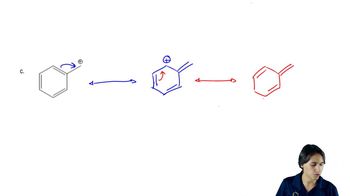
Drawing Resonance Structures

Delocalization of Electrons

Delocalization of electrons refers to the spreading of electron density across multiple atoms rather than being localized between two. In the pentadienyl radical, the unpaired electron is delocalized over three carbon atoms, which stabilizes the radical. This delocalization is a key factor in understanding the behavior of radicals in chemical reactions, as it influences their reactivity and the types of products formed.
Recommended video:
Guided course
03:54
The 18 and 16 Electron Rule