The reaction of (R)-1-iodo-2-methylbutane with hydroxide ion forms an alcohol without breaking any bonds to the asymmetric center. The alcohol rotates the plane of polarization of plane-polarized light counterclockwise. What is the configuration of (+)-2-methyl-1-butanol?
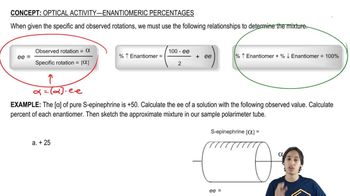
(+)-Mandelic acid has a specific rotation of +158. What would be the observed specific rotation of each of the following mixtures?
c. 75% (-)-mandelic acid and 25% (+)-mandelic acid
Verified step by step guidance
Verified video answer for a similar problem:
Key Concepts
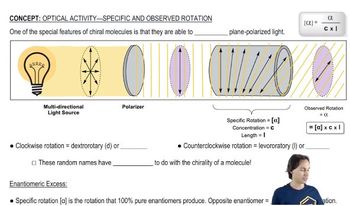
Specific Rotation
Enantiomers
Optical Purity
The following compound has only one asymmetric center. Why then does it have four stereoisomers?
a. Stereoisomers with two asymmetric centers are called ___ if the configuration of both asymmetric centers in one stereoisomer is the opposite of the configuration of the symmetric centers in the other stereoisomer.
b. Stereoisomers with two asymmetric centers are called ___ if the configuration of both asymmetric centers in one stereoisomer is the same as the configuration of the asymmetric centers in the other stereoisomer.
c. Stereoisomers with two asymmetric centers are called ___ if one of the asymmetric centers has the same configuration in both stereoisomers and the other asymmetric center has the opposite configuration in the two stereoisomers.

What is the configuration of the following compounds? (Use the given structures to answer the question.)
c. ()-lactic acid
The observed rotation of 2.0 g of a compound in 50 mL of solution in a polarimeter tube 20 cm long is +138°. What is the specific rotation of the compound?
Naproxen, a nonsteroidal anti-inflammatory drug that is the active ingredient in Aleve (p. 115), has a specific rotation of +66. One commercial preparation results in a mixture with a 97% enantiomeric excess.
a. Does naproxen have the R or the S configuration?
b. What percent of each enantiomer is obtained from the commercial preparation?