

Ch. 13 - Nuclear Magnetic Resonance Spectroscopy
Wade - Organic Chemistry 9th Edition
Wade9th EditionOrganic ChemistryISBN: 9780135213728Not the one you use?Change textbook
Chapter 13, Problem 34a,b

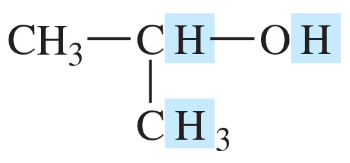
Predict the multiplicity (the number of peaks as a result of splitting) and the chemical shift for each shaded proton in the following compounds.
(a)
(b)

Verified step by step guidance
1
Step 1: Analyze the structure of compound (a) CH3-CH2-CCl2-CH3. Identify the shaded protons and their neighboring protons. The shaded protons are part of CH3, CH2, and CH3 groups. The splitting pattern is determined by the n+1 rule, where n is the number of neighboring protons.
Step 2: For the CH3 group attached to CH2, the shaded protons will experience splitting due to the two protons on the adjacent CH2 group. Using the n+1 rule, the multiplicity will be a triplet (n=2, so 2+1=3). The chemical shift will be in the range of 0.9-1.0 ppm, typical for alkyl CH3 groups.
Step 3: For the CH2 group, the shaded protons will experience splitting due to the three protons on the adjacent CH3 group. Using the n+1 rule, the multiplicity will be a quartet (n=3, so 3+1=4). The chemical shift will be in the range of 1.2-1.5 ppm, typical for alkyl CH2 groups.
Step 4: For the CH3 group attached to CCl2, the shaded protons will not experience splitting because there are no neighboring protons. The multiplicity will be a singlet. The chemical shift will be slightly downfield, around 1.5-2.0 ppm, due to the electron-withdrawing effect of the CCl2 group.
Step 5: Analyze compound (b) CH3-CH(OCH3)-CH3. For the shaded proton on the CH group, it is adjacent to two CH3 groups. Using the n+1 rule, the multiplicity will be a doublet (n=1 from each CH3 group, so 1+1=2). The chemical shift will be around 3.5-4.0 ppm due to the electron-withdrawing effect of the OCH3 group. For the shaded proton on the OH group, it will appear as a singlet due to the lack of coupling with other protons, and its chemical shift will be around 2.0-4.0 ppm depending on hydrogen bonding.

Verified video answer for a similar problem:

This video solution was recommended by our tutors as helpful for the problem above.
Video duration:
7m
Was this helpful?

Key Concepts

Here are the essential concepts you must grasp in order to answer the question correctly.

Nuclear Magnetic Resonance (NMR) Spectroscopy

NMR spectroscopy is a powerful analytical technique used to determine the structure of organic compounds. It relies on the magnetic properties of certain nuclei, primarily hydrogen (1H) and carbon (13C), to provide information about the environment surrounding these nuclei. The resulting spectra reveal chemical shifts and multiplicity, which help identify the number of neighboring protons and the electronic environment of each proton.
Recommended video:
Guided course
10:06
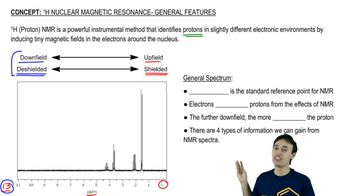
General NMR Features

Chemical Shift

Chemical shift refers to the position of a peak in an NMR spectrum, measured in parts per million (ppm). It indicates the electronic environment of the protons in a molecule, influenced by factors such as electronegativity and hybridization. Protons in different environments resonate at different frequencies, allowing chemists to deduce structural information about the compound based on the chemical shifts observed in the spectrum.
Recommended video:
Guided course
11:44
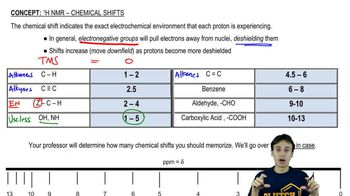
1H NMR Chemical Shifts

Multiplicity and Splitting Patterns

Multiplicity in NMR refers to the number of peaks observed for a given proton signal, which results from the splitting of the signal due to neighboring protons. This phenomenon is described by the n+1 rule, where 'n' is the number of neighboring protons. Understanding multiplicity helps in determining the number of adjacent protons and provides insight into the connectivity and arrangement of atoms within the molecule.
Recommended video:
Guided course
08:06
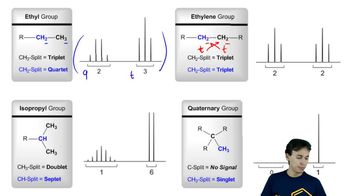
Common Splitting Patterns
Related Practice
Textbook Question

A laboratory student was converting cyclohexanol to cyclohexyl bromide by using one equivalent of sodium bromide in a large excess of concentrated sulfuric acid. The major product she recovered was not cyclohexyl bromide, but a compound of formula C6H10 that gave the following 13C NMR spectrum:

<IMAGE>

(a) Propose a structure for this product.

(b) Assign the peaks in the 13C NMR spectrum to the carbon atoms in the structure.

(c) Suggest modifications in the reaction to obtain a better yield of cyclohexyl bromide.

1
views
Textbook Question

The following proton NMR spectrum is of a compound of molecular formula C3H8O.

<IMAGE>

(a) Propose a structure for this compound.

(b) Assign peaks to show which protons give rise to which signals in the spectrum.

1
views
Textbook Question

Predict the approximate chemical shifts of the protons in the following compounds.

(c) CH3–O–CH2CH2CH2Cl

(d) CH3CH2–C≡C–H

1
views
Textbook Question

An unknown compound has the molecular formula C9H11Br. Its proton NMR spectrum shows the following absorptions:

singlet, δ7.1, integral 44 mm

singlet, δ2.3, integral 130 mm

singlet, δ2.2, integral 67 mm

Propose a structure for this compound.

1
views
Textbook Question

An inexperienced graduate student was making some 4-hydroxybutanoic acid. He obtained an excellent yield of a different compound, whose 13C NMR spectrum is shown here.

<IMAGE>

(a) Propose a structure for this product.

(b) Assign the peaks in the 13C NMR spectrum to the carbon atoms in the structure.

2
views
Textbook Question

Using a 60-MHz spectrometer, a chemist observes the following absorption: doublet, J = 7 Hz, at δ4.00

(a) What would the chemical shift (δ) be in the 300-MHz spectrum?

(b) What would the splitting value J be in the 300-MHz spectrum?

(c) How many hertz from the TMS peak is this absorption in the 60-MHz spectrum? In the 300-MHz spectrum?

3
views