
Ch. 13 - Nuclear Magnetic Resonance Spectroscopy
Wade - Organic Chemistry 9th Edition
Wade9th EditionOrganic ChemistryISBN: 9780135213728Not the one you use?Change textbook
Chapter 13, Problem 35c,d

Predict the approximate chemical shifts of the protons in the following compounds.
(c) CH3–O–CH2CH2CH2Cl
(d) CH3CH2–C≡C–H

Verified step by step guidance
1
Step 1: Analyze the structure of compound (c) CH3-O-CH2CH2CH2Cl. Identify the different proton environments. The protons labeled 'b' are part of the CH3 group attached to the oxygen atom, and the protons labeled 'a' are part of the CH2 groups in the chain. The terminal CH2 group is adjacent to the electronegative chlorine atom, which will deshield its protons.
Step 2: Predict the chemical shifts for compound (c). The CH3 protons ('b') attached to the oxygen will experience a slight deshielding effect due to the electronegativity of oxygen, leading to a chemical shift around 3.3-3.8 ppm. The CH2 protons ('a') in the middle of the chain will have a chemical shift around 1.2-1.5 ppm, while the CH2 protons adjacent to the chlorine atom will be more deshielded, with a chemical shift around 3.5-4.0 ppm.
Step 3: Analyze the structure of compound (d) CH3CH2-C≡C-H. Identify the different proton environments. The protons labeled 'b' are part of the CH3 group, and the protons labeled 'a' are part of the CH2 group. The terminal proton attached to the triple bond ('a') is unique due to its proximity to the sp-hybridized carbon.
Step 4: Predict the chemical shifts for compound (d). The CH3 protons ('b') will have a chemical shift around 0.9 ppm, typical for alkyl groups. The CH2 protons ('a') adjacent to the triple bond will experience a slight deshielding effect, leading to a chemical shift around 1.8-2.2 ppm. The terminal proton attached to the triple bond ('a') will have a chemical shift around 2.5-3.0 ppm due to the deshielding effect of the sp-hybridized carbon.
Step 5: Summarize the reasoning. The chemical shifts are influenced by the electronegativity of nearby atoms and the hybridization of the carbon atoms. Oxygen and chlorine cause deshielding effects, while sp-hybridized carbons also contribute to unique chemical shifts for nearby protons.

Verified video answer for a similar problem:

This video solution was recommended by our tutors as helpful for the problem above.
Video duration:
4m
Was this helpful?

Key Concepts

Here are the essential concepts you must grasp in order to answer the question correctly.

Chemical Shifts in NMR Spectroscopy

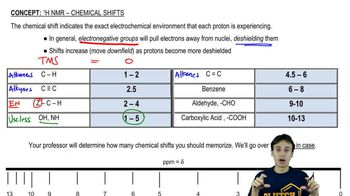
Chemical shifts in NMR spectroscopy refer to the resonance frequency of a nucleus relative to a standard in a magnetic field. They are influenced by the electronic environment surrounding the nucleus, which can be affected by factors such as electronegativity, hybridization, and the presence of nearby functional groups. Understanding these shifts is crucial for interpreting NMR spectra and identifying molecular structures.
Recommended video:
Guided course
11:44
1H NMR Chemical Shifts

Proton Environments

In organic compounds, protons (hydrogens) can exist in different environments based on their connectivity and surrounding atoms. Each unique environment contributes to a distinct chemical shift in the NMR spectrum. For example, protons attached to carbon atoms adjacent to electronegative atoms like oxygen will resonate at different frequencies compared to those in aliphatic or aromatic systems, which is essential for predicting chemical shifts.
Recommended video:
Guided course
03:
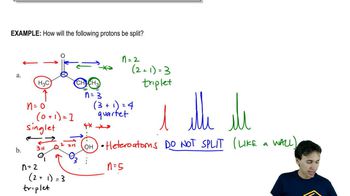
Proton Splitting

Effect of Functional Groups

Functional groups significantly influence the chemical shifts of protons in NMR spectroscopy. For instance, protons on carbons adjacent to electronegative atoms (like oxygen in ethers) typically appear downfield (higher ppm) due to deshielding effects. Conversely, protons in alkenes or alkynes experience shifts based on their hybridization and the degree of substitution, making it important to consider these groups when predicting shifts.
Recommended video:
Guided course
02:36
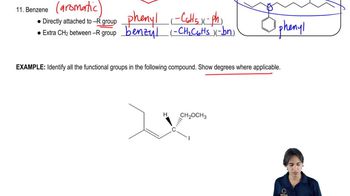
Identifying Functional Groups
Related Practice
Textbook Question

A laboratory student was converting cyclohexanol to cyclohexyl bromide by using one equivalent of sodium bromide in a large excess of concentrated sulfuric acid. The major product she recovered was not cyclohexyl bromide, but a compound of formula C6H10 that gave the following 13C NMR spectrum:

<IMAGE>

(a) Propose a structure for this product.

(b) Assign the peaks in the 13C NMR spectrum to the carbon atoms in the structure.

(c) Suggest modifications in the reaction to obtain a better yield of cyclohexyl bromide.

1
views
Textbook Question

The following proton NMR spectrum is of a compound of molecular formula C3H8O.

<IMAGE>

(a) Propose a structure for this compound.

(b) Assign peaks to show which protons give rise to which signals in the spectrum.

1
views
Textbook Question

An unknown compound has the molecular formula C9H11Br. Its proton NMR spectrum shows the following absorptions:

singlet, δ7.1, integral 44 mm

singlet, δ2.3, integral 130 mm

singlet, δ2.2, integral 67 mm

Propose a structure for this compound.

1
views
Textbook Question

Predict the multiplicity (the number of peaks as a result of splitting) and the chemical shift for each shaded proton in the following compounds.

(a)

(b)

1
views
Textbook Question

Sketch your predictions of the proton NMR spectra of the following compounds.

(a) CH3–O–CH2CH3

2
views
Textbook Question

Using a 60-MHz spectrometer, a chemist observes the following absorption: doublet, J = 7 Hz, at δ4.00

(a) What would the chemical shift (δ) be in the 300-MHz spectrum?

(b) What would the splitting value J be in the 300-MHz spectrum?

(c) How many hertz from the TMS peak is this absorption in the 60-MHz spectrum? In the 300-MHz spectrum?

3
views