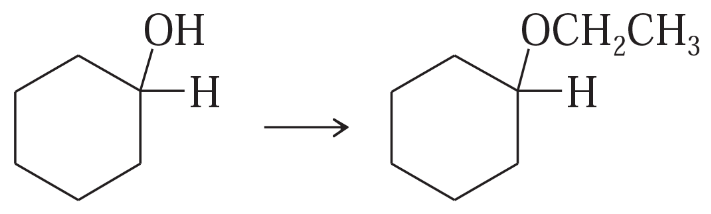
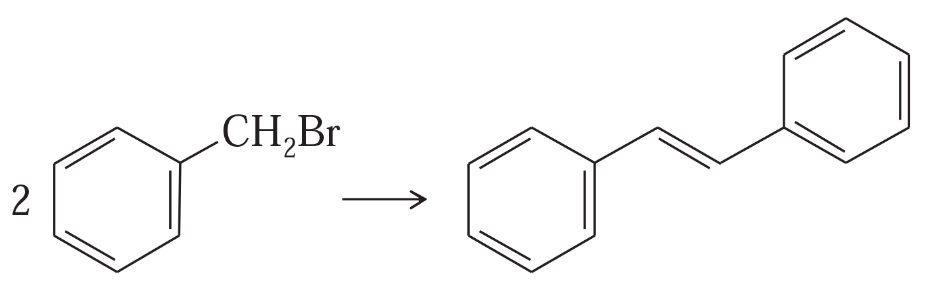
Show how you would accomplish the following synthetic conversions. (a) (b)
Verified step by step guidance
1
Step 1: For part (a), identify the functional group transformation. The starting material is cyclohexanol (an alcohol), and the product is cyclohexyl ethyl ether. This indicates that the reaction involves ether formation, likely through Williamson ether synthesis.
Step 2: In Williamson ether synthesis, the alcohol is first converted into an alkoxide ion by reacting it with a strong base such as sodium hydride (NaH) or potassium hydroxide (KOH). This deprotonates the alcohol to form the cyclohexoxide ion.
Step 3: The alkoxide ion then reacts with an alkyl halide, such as ethyl bromide (CH3CH2Br), in an SN2 reaction. This results in the formation of the ether bond, yielding cyclohexyl ethyl ether.
Step 4: For part (b), identify the functional group transformation. The starting material is benzyl bromide (C6H5CH2Br), and the product is stilbene (C6H5CH=CHC6H5). This indicates that the reaction involves coupling and elimination to form a double bond.
Step 5: Benzyl bromide undergoes a coupling reaction, likely through a Wurtz reaction mechanism. In the presence of sodium metal (Na), two benzyl bromide molecules react to form a stilbene structure via elimination of bromine and formation of a carbon-carbon double bond.
Verified video answer for a similar problem:
This video solution was recommended by our tutors as helpful for the problem above
Video duration:
14m
Play a video:
0 Comments
Key Concepts
Here are the essential concepts you must grasp in order to answer the question correctly.
Nucleophilic Substitution
Nucleophilic substitution is a fundamental reaction in organic chemistry where a nucleophile attacks an electrophile, replacing a leaving group. In the context of the provided reaction, the hydroxyl group (OH) acts as a leaving group, and the alkyl group (OCH2CH3) is introduced through this substitution process, resulting in the formation of an ether.
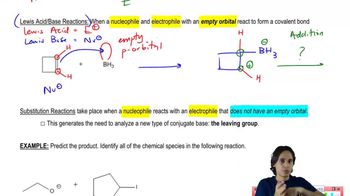
Nucleophiles and Electrophiles can react in Substitution Reactions.
Reactivity of Alcohols
Alcohols are versatile compounds that can undergo various reactions due to the presence of the hydroxyl (-OH) group. In this case, the alcohol is converted into an ether, which typically requires activation of the alcohol to enhance its reactivity, often through protonation or conversion to a better leaving group, facilitating the nucleophilic attack.
The formation of ethers from alcohols can occur via several mechanisms, including the Williamson ether synthesis. This involves the reaction of an alkoxide ion with a primary alkyl halide or a suitable electrophile. Understanding the mechanism is crucial for predicting the outcome of the reaction and ensuring the correct conditions are applied for successful ether synthesis.