What are the products of the following reactions? c.
Verified step by step guidance
1
Step 1: Recognize the reaction type. This is a Friedel-Crafts acylation reaction, where an aromatic compound reacts with an acyl chloride in the presence of a Lewis acid catalyst (AlCl₃).
Step 2: Identify the reactants. The aromatic compound is benzene, and the acyl chloride is benzoyl chloride (C₆H₅COCl). The catalyst is aluminum chloride (AlCl₃).
Step 3: Understand the mechanism. The AlCl₃ catalyst interacts with the acyl chloride to form a highly electrophilic acylium ion (C₆H₅CO⁺), which is the active species in the reaction.
Step 4: Predict the electrophilic aromatic substitution. The acylium ion attacks the benzene ring, leading to the formation of a new carbon-carbon bond. This results in the substitution of a hydrogen atom on the benzene ring with the acyl group (C₆H₅CO).
Step 5: Finalize the product. The product of this reaction is acetophenone (C₆H₅COC₆H₆), where the benzene ring is bonded to the carbonyl group of the acyl chloride. The AlCl₃ catalyst is regenerated at the end of the reaction.
Verified video answer for a similar problem:
This video solution was recommended by our tutors as helpful for the problem above
Video duration:
2m
Play a video:
0 Comments
Key Concepts
Here are the essential concepts you must grasp in order to answer the question correctly.
Friedel-Crafts Acylation
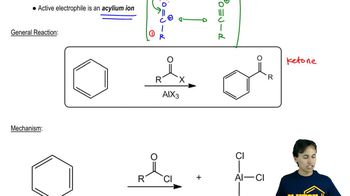
Friedel-Crafts acylation is an electrophilic aromatic substitution reaction where an acyl group is introduced into an aromatic ring. This reaction typically involves the use of an acyl chloride and a Lewis acid catalyst, such as aluminum chloride (AlCl3), which activates the acyl chloride to form a more reactive acylium ion. The acylium ion then reacts with the aromatic compound, resulting in the formation of a ketone substituted on the aromatic ring.
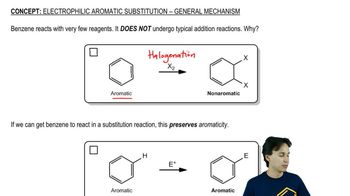
Electrophilic aromatic substitution is a fundamental reaction mechanism in organic chemistry where an electrophile replaces a hydrogen atom on an aromatic ring. The aromatic system's electron-rich nature allows it to react with electrophiles, leading to the formation of a new carbon-electrophile bond. This mechanism is crucial for understanding various reactions involving aromatic compounds, including Friedel-Crafts reactions.
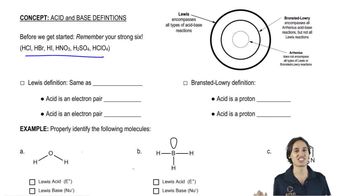
Lewis acids are substances that can accept an electron pair from a Lewis base, facilitating various chemical reactions. In the context of Friedel-Crafts acylation, aluminum chloride (AlCl3) acts as a Lewis acid by coordinating with the acyl chloride, enhancing its electrophilicity. This interaction is essential for generating the acylium ion, which is the active electrophile that reacts with the aromatic compound.

 2:34 minutes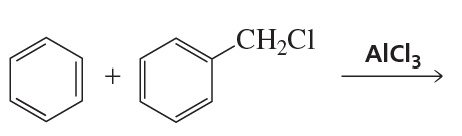
 Verified step by step guidance
 05:20
05:20