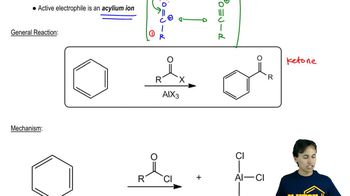
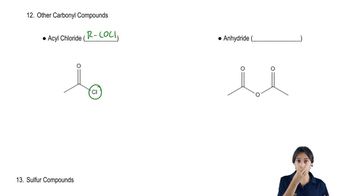
Show the mechanism for the generation of the acylium ion if an acid anhydride is used instead of an acyl chloride for the source of the acylium ion.
Verified step by step guidance
1
Step 1: Recognize that the acid anhydride is the source of the acylium ion. Acid anhydrides are compounds with two acyl groups bonded to an oxygen atom. In this case, the acid anhydride reacts with a Lewis acid catalyst, AlCl₃, to generate the acylium ion.
Step 2: The Lewis acid, AlCl₃, interacts with one of the carbonyl oxygen atoms in the acid anhydride. This interaction increases the electrophilicity of the carbonyl carbon, making it more susceptible to nucleophilic attack.
Step 3: A cleavage occurs in the acid anhydride. The bond between the carbonyl carbon and the oxygen atom breaks, resulting in the formation of the acylium ion (R-C≡O⁺) and a carboxylate ion (R-COO⁻). The acylium ion is stabilized by resonance, where the positive charge is delocalized between the carbon and oxygen atoms.
Step 4: The carboxylate ion formed in the previous step can coordinate with the AlCl₃ catalyst, forming a complex. This complex stabilizes the carboxylate ion and prevents it from interfering with the reaction.
Step 5: The acylium ion is now available to participate in electrophilic aromatic substitution reactions, such as Friedel-Crafts acylation, where it reacts with the benzene ring to form an aromatic ketone.
Verified video answer for a similar problem:
This video solution was recommended by our tutors as helpful for the problem above
Video duration:
5m
Play a video:
0 Comments
Key Concepts
Here are the essential concepts you must grasp in order to answer the question correctly.
Acylium Ion Formation
The acylium ion is a resonance-stabilized cation formed from acyl compounds, such as acyl chlorides or acid anhydrides. In the presence of a Lewis acid like AlCl3, the carbonyl carbon of the acyl compound becomes electrophilic, allowing for the generation of the acylium ion. This ion is crucial in electrophilic aromatic substitution reactions, particularly in Friedel-Crafts acylation.
Friedel-Crafts acylation is a reaction that introduces an acyl group into an aromatic ring using an acylium ion. The process involves the electrophilic attack of the acylium ion on the aromatic system, followed by deprotonation to restore aromaticity. This reaction is significant for synthesizing ketones from aromatic compounds and is facilitated by Lewis acids that activate the acylium ion.
Acid anhydrides and acyl chlorides are both sources of acylium ions, but they differ in reactivity and byproducts. Acid anhydrides are generally less reactive than acyl chlorides, leading to milder reaction conditions. When using acid anhydrides, the reaction produces a carboxylic acid as a byproduct, while acyl chlorides yield hydrochloric acid. Understanding these differences is essential for predicting reaction outcomes in acylation processes.

 5:03 minutes
 Verified step by step guidance
 3:39
3:39