Ch. 17 - Reactions at the Alpha-Carbon
Bruice - Organic Chemistry 8th Edition
Bruice8th EditionOrganic ChemistryISBN: 9780135213711Not the one you use?Change textbook
Chapter 18, Problem 34

Can 2,4-pentanedione undergo an intramolecular aldol addition? If so, why? If not, why not?

Verified step by step guidance
1
Identify the functional groups in 2,4-pentanedione. It contains two ketone groups at positions 2 and 4, making it a 1,3-diketone.
Recall the requirements for an intramolecular aldol addition. This reaction occurs when a compound has two carbonyl groups (aldehydes or ketones) that are close enough to form a stable cyclic product upon reaction.
Determine if 2,4-pentanedione can form an enolate ion. The alpha-hydrogens (hydrogens on the carbon adjacent to a carbonyl group) in 2,4-pentanedione are acidic and can be deprotonated to form an enolate ion.
Analyze the potential for cyclization. The enolate ion formed from one carbonyl group can attack the carbonyl carbon of the other group, forming a new C-C bond. In this case, the reaction would result in the formation of a five-membered ring, which is generally stable.
Conclude that 2,4-pentanedione can undergo an intramolecular aldol addition because it meets the criteria: it has two carbonyl groups, acidic alpha-hydrogens to form an enolate, and the ability to form a stable five-membered ring upon cyclization.

Verified video answer for a similar problem:

This video solution was recommended by our tutors as helpful for the problem above.
Video duration:
4m
Was this helpful?

Key Concepts

Here are the essential concepts you must grasp in order to answer the question correctly.

Aldol Addition

Aldol addition is a reaction in which an enolate ion reacts with a carbonyl compound to form a β-hydroxy carbonyl compound. This reaction typically occurs between two aldehydes or ketones, leading to the formation of larger molecules. Understanding this process is crucial for analyzing whether a compound can undergo intramolecular aldol addition.
Recommended video:
Guided course
09:51
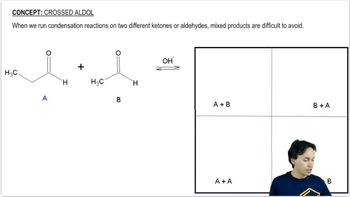
Crossed Aldol

Intramolecular Reactions

Intramolecular reactions occur within a single molecule, where functional groups are positioned such that they can react with each other. In the case of intramolecular aldol addition, the distance between the reactive carbonyl and enolate groups must be suitable for the reaction to occur. This concept is essential for determining if 2,4-pentanedione can form a cyclic product through intramolecular aldol addition.
Recommended video:
2:29
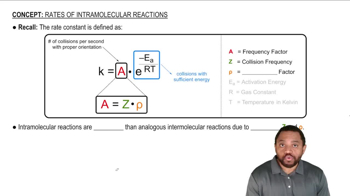
Rates of Intramolecular Reactions Concept 1

Structural Features of 2,4-Pentanedione

2,4-Pentanedione is a diketone with two carbonyl groups located at the 2 and 4 positions of a five-carbon chain. Its structure allows for the formation of an enolate at one carbonyl, which can then react with the other carbonyl within the same molecule. Recognizing these structural features is vital for assessing the feasibility of intramolecular aldol addition in this compound.
Recommended video:
1:09
Secondary Protein Structure Example 4