Ch. 17 - Reactions at the Alpha-Carbon
Bruice - Organic Chemistry 8th Edition
Bruice8th EditionOrganic ChemistryISBN: 9780135213711Not the one you use?Change textbook
Chapter 18, Problem 35c

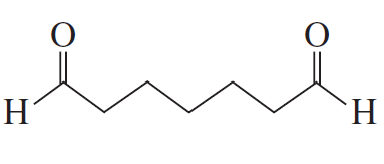
Draw the product of the reaction of each of the following compounds with a base:
c. Structural representation of a compound involved in intramolecular aldol condensation, showing hydroxyl and carbonyl groups.

Verified step by step guidance
1
Step 1: Identify the functional groups in the compound. The given compound contains two ketone groups (C=O) separated by a central carbon atom with a methyl group attached.
Step 2: Determine the reactivity of the compound with a base. Ketones have acidic alpha-hydrogens due to the resonance stabilization of the enolate ion formed upon deprotonation.
Step 3: Locate the alpha-hydrogens. The alpha-hydrogens are the hydrogens attached to the carbon atoms adjacent to the carbonyl groups. In this compound, there are alpha-hydrogens on both sides of the central carbon atom.
Step 4: Predict the reaction mechanism. When treated with a base, one of the alpha-hydrogens will be abstracted, leading to the formation of an enolate ion. The enolate ion is stabilized by resonance between the oxygen atom and the alpha-carbon.
Step 5: Draw the product. The product will be the enolate ion formed after deprotonation of one of the alpha-hydrogens. The resonance structure should show the negative charge delocalized between the oxygen atom and the alpha-carbon.

Verified video answer for a similar problem:

This video solution was recommended by our tutors as helpful for the problem above.
Video duration:
5m
Was this helpful?

Key Concepts

Here are the essential concepts you must grasp in order to answer the question correctly.

Aldol Condensation

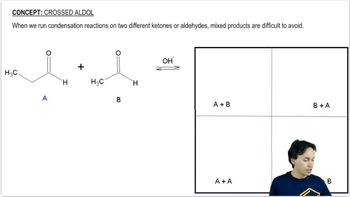
Aldol condensation is a reaction between aldehydes or ketones that contain alpha-hydrogens, leading to the formation of β-hydroxy aldehydes or ketones. This reaction typically occurs in the presence of a base, which deprotonates the alpha-hydrogen, allowing the formation of an enolate ion. The enolate then attacks the carbonyl carbon of another molecule, resulting in a new carbon-carbon bond. The final step involves dehydration to yield an α,β-unsaturated carbonyl compound.
Recommended video:
Guided course
09:51
Crossed Aldol

Intramolecular Reactions

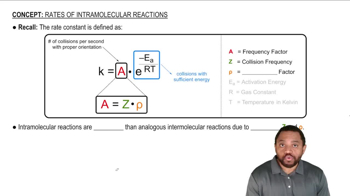
Intramolecular reactions occur within a single molecule, where functional groups react with each other to form a new structure. In the context of aldol condensation, an intramolecular aldol reaction can lead to the formation of cyclic compounds. This is favored when the distance between the reactive groups is suitable for ring closure, often resulting in more stable cyclic structures compared to their linear counterparts.
Recommended video:
2:29
Rates of Intramolecular Reactions Concept 1

Base Catalysis

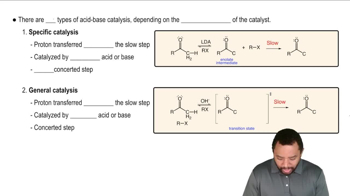
Base catalysis involves the use of a base to facilitate a chemical reaction by increasing the nucleophilicity of a reactant. In aldol condensation, a base such as sodium hydroxide or potassium hydroxide is used to deprotonate the alpha-hydrogen of the carbonyl compound, generating an enolate ion. This ion is a stronger nucleophile, allowing it to effectively attack another carbonyl carbon, thus driving the reaction forward and enhancing the overall yield of the product.
Recommended video:
2:50
Acid-Base Catalysis Concept 3