Ch. 6 - Stereoisomerism: Arrangement of Atoms in Space
Mullins - Organic Chemistry: A Learner Centered Approach 1st Edition
Mullins1st EditionOrganic Chemistry: A Learner Centered ApproachISBN: 9780137566471Not the one you use?Change textbook
Chapter 5, Problem 8f

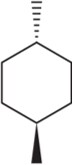
Identify all planes of symmetry in the following molecules/conformations, if any.
(f) Diagram of a hexagonal molecule with a conical structure below and a dashed line indicating a plane of symmetry above.

Verified step by step guidance
1
Step 1: Begin by understanding the concept of a plane of symmetry. A plane of symmetry is an imaginary plane that divides a molecule into two mirror-image halves. If such a plane exists, the molecule is considered achiral.
Step 2: Analyze the molecular structure provided in part (f). Look for elements of symmetry such as identical groups or atoms on opposite sides of the molecule that could indicate the presence of a plane of symmetry.
Step 3: Consider the conformation of the molecule. If the molecule is flexible and can adopt different conformations, determine whether any of these conformations exhibit a plane of symmetry. For example, in cyclic molecules, planar conformations often have symmetry planes.
Step 4: Use visualization techniques or molecular modeling tools to identify potential planes of symmetry. Draw the molecule in 3D or use software to rotate and inspect the molecule from different angles.
Step 5: Confirm the presence of a plane of symmetry by ensuring that all atoms and groups on one side of the plane are identical to their counterparts on the other side. If no such plane exists, the molecule does not have a plane of symmetry.

Verified video answer for a similar problem:

This video solution was recommended by our tutors as helpful for the problem above.
Video duration:
40s
Was this helpful?

Key Concepts

Here are the essential concepts you must grasp in order to answer the question correctly.

Symmetry in Molecules

Symmetry in molecules refers to the balanced and proportionate arrangement of atoms in a molecule. It can be classified into different types, such as rotational symmetry, mirror planes, and inversion centers. Understanding symmetry helps in predicting molecular behavior, reactivity, and physical properties, as symmetrical molecules often exhibit unique characteristics.
Recommended video:
Guided course
00:25
Determining Chirality with Plane of Symmetry

Planes of Symmetry

A plane of symmetry is an imaginary plane that divides a molecule into two mirror-image halves. If a molecule has one or more planes of symmetry, it is considered symmetrical. Identifying these planes is crucial for determining the chirality of a molecule, as chiral molecules lack any planes of symmetry and cannot be superimposed on their mirror images.
Recommended video:
Guided course
02:58
Determining Chirality with Plane of Symmetry

Conformational Analysis

Conformational analysis involves studying the different spatial arrangements of atoms in a molecule that can occur due to rotation around single bonds. These conformations can affect the symmetry of the molecule, as certain arrangements may introduce or eliminate planes of symmetry. Analyzing conformations is essential for understanding the stability and reactivity of molecules in organic chemistry.
Recommended video:
Guided course
03:29
Understanding what a conformer is.