
Ch.6 - Alkyl Halides; Nucleophilic Substitution
Wade - Organic Chemistry 9th Edition
Wade9th EditionOrganic ChemistryISBN: 9780135213728Not the one you use?Change textbook
Chapter 6, Problem 59b

A student adds NBS to a solution of 1-methylcyclohexene and irradiates the mixture with a sunlamp until all the NBS has reacted. After a careful distillation, the product mixture contains two major products of formula C7H11Br.
b. Rank these three intermediates from most stable to least stable.

Verified step by step guidance
1
Identify the reaction type: The reaction involves NBS (N-Bromosuccinimide) and light (hv), which indicates an allylic bromination reaction. This reaction selectively brominates the allylic position of alkenes.
Determine the possible allylic positions: In 1-methylcyclohexene, the double bond is between two carbons in the cyclohexene ring. The allylic positions are the carbons adjacent to the double bond. Analyze the structure to identify all possible allylic carbons.
Generate the allylic radicals: When the reaction occurs, the bromine radical abstracts a hydrogen atom from the allylic positions, forming allylic radicals. Draw the possible allylic radicals and consider resonance structures to determine their stability.
Rank the stability of the intermediates: The stability of allylic radicals depends on resonance delocalization and the degree of substitution. More substituted radicals and those with greater resonance stabilization are more stable. Rank the radicals based on these criteria.
Conclude the ranking: Based on the analysis, rank the three intermediates (allylic radicals) from most stable to least stable. This ranking will help explain the major products observed in the reaction.

Verified video answer for a similar problem:

This video solution was recommended by our tutors as helpful for the problem above.
Video duration:
6m
Was this helpful?

Key Concepts

Here are the essential concepts you must grasp in order to answer the question correctly.

Radical Stability

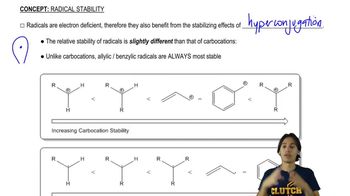
Radical stability refers to the relative stability of radical intermediates formed during reactions. Factors influencing stability include the degree of substitution (tertiary radicals are more stable than secondary, which are more stable than primary) and resonance effects. In the context of the reaction with NBS, understanding the stability of the radical intermediates is crucial for predicting the major products formed.
Recommended video:
Guided course
03:43
The radical stability trend.

Electrophilic Addition Reactions

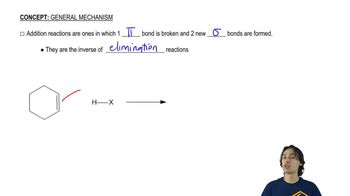
Electrophilic addition reactions involve the addition of an electrophile to a nucleophile, typically across a double bond. In this case, NBS acts as an electrophile, adding bromine to the alkene (1-methylcyclohexene). Recognizing the mechanism of this addition helps in understanding the formation of the products and the intermediates involved in the reaction.
Recommended video:
Guided course
05:39
Features of Addition Mechanisms.

Distillation and Product Separation

Distillation is a separation technique used to purify liquids based on differences in boiling points. After the reaction, distillation is employed to isolate the products from unreacted materials and byproducts. Understanding the principles of distillation is essential for analyzing the resulting product mixture and determining the composition of the major products formed in the reaction.
Recommended video:
Guided course
11:07
Bridged-Products