
Ch.6 - Alkyl Halides; Nucleophilic Substitution
Wade - Organic Chemistry 9th Edition
Wade9th EditionOrganic ChemistryISBN: 9780135213728Not the one you use?Change textbook
Chapter 6, Problem 58c

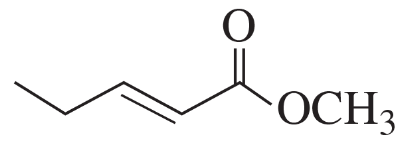
Show the products you expect when each compound reacts with NBS with light shining on the reaction.
(c)

Verified step by step guidance
1
Step 1: Recognize that NBS (N-Bromosuccinimide) in the presence of light is used for allylic bromination. This reaction selectively replaces a hydrogen atom at the allylic position (the carbon adjacent to a double bond) with a bromine atom.
Step 2: Identify the allylic positions in the given compound. The compound contains a double bond, and the carbons adjacent to this double bond are the allylic positions. These are the carbons directly connected to the double bond but not part of it.
Step 3: Determine the most stable allylic radical that can form during the reaction. When the allylic hydrogen is abstracted, the resulting radical is stabilized by resonance. Draw resonance structures to confirm the stability of the allylic radical.
Step 4: Add a bromine atom to the allylic radical to form the brominated product. The bromine will attach to the carbon where the radical was formed.
Step 5: Consider regioselectivity and stereochemistry if applicable. If multiple allylic positions are available, the major product will typically form at the position that leads to the most stable radical intermediate. Draw the expected product(s) based on this analysis.

Verified video answer for a similar problem:

This video solution was recommended by our tutors as helpful for the problem above.
Video duration:
3m
Was this helpful?

Key Concepts

Here are the essential concepts you must grasp in order to answer the question correctly.

NBS (N-Bromosuccinimide) Reactivity

NBS is a reagent commonly used in organic chemistry for bromination reactions, particularly in the presence of light. It generates bromine radicals upon photolysis, which can abstract hydrogen atoms from alkenes or allylic positions, leading to the formation of brominated products. Understanding how NBS interacts with different functional groups is crucial for predicting the products of the reaction.
Recommended video:
Guided course
01:17
Reactivity of Molecules

Radical Mechanism

The reaction mechanism involving NBS and light typically follows a radical pathway. This includes initiation (formation of radicals), propagation (reaction of radicals with substrates), and termination (recombination of radicals). Recognizing the steps of radical mechanisms helps in predicting the outcome of reactions, especially in terms of regioselectivity and stereochemistry.
Recommended video:
Guided course
03:28
The mechanism of Radical Polymerization.

Allylic Bromination

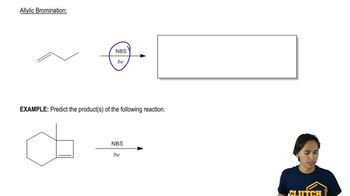
Allylic bromination refers to the substitution of hydrogen atoms at the allylic position (the carbon adjacent to a double bond) with bromine. This process is favored in reactions involving NBS and light, as the formation of a stable allylic radical intermediate allows for selective bromination. Understanding this concept is essential for determining the expected products when the compound in the question reacts with NBS.
Recommended video:
Guided course
00:54
Mechanism of Allylic Bromination.