Ch. 13 - Mass Spectrometry; Infrared Spectroscopy; UV/Vis Spectroscopy
Bruice - Organic Chemistry 8th Edition
Bruice8th EditionOrganic ChemistryISBN: 9780135213711Not the one you use?Change textbook
Chapter 14, Problem 26

Which shows an O–H stretch at a larger wavenumber: ethanol dissolved in carbon disulfide or an undiluted sample of ethanol?

Verified step by step guidance
1
Understand the concept of hydrogen bonding: The O-H stretch in an IR spectrum is influenced by hydrogen bonding. Stronger hydrogen bonding lowers the wavenumber of the O-H stretch due to the weakening of the O-H bond.
Analyze the environment of ethanol in carbon disulfide: When ethanol is dissolved in carbon disulfide (CS₂), a non-polar solvent, hydrogen bonding between ethanol molecules is disrupted because CS₂ does not participate in hydrogen bonding.
Analyze the environment of undiluted ethanol: In an undiluted sample of ethanol, ethanol molecules are in close proximity and can form strong intermolecular hydrogen bonds with each other.
Compare the effects on the O-H stretch: In the case of ethanol dissolved in CS₂, the O-H bond is less involved in hydrogen bonding, so the O-H stretch appears at a higher wavenumber. In undiluted ethanol, the strong hydrogen bonding shifts the O-H stretch to a lower wavenumber.
Conclude: Ethanol dissolved in carbon disulfide shows an O-H stretch at a larger wavenumber compared to undiluted ethanol due to the absence of significant hydrogen bonding in the dissolved state.

Verified video answer for a similar problem:

This video solution was recommended by our tutors as helpful for the problem above.
Video duration:
3m
Was this helpful?

Key Concepts

Here are the essential concepts you must grasp in order to answer the question correctly.

Infrared Spectroscopy

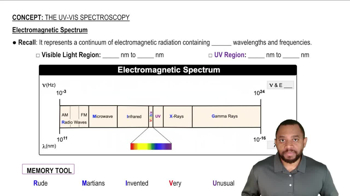
Infrared spectroscopy is a technique used to identify molecular structures by measuring the absorption of infrared light, which causes molecular vibrations. Different functional groups absorb light at characteristic wavenumbers, allowing for the identification of specific bonds, such as O-H stretches in alcohols.
Recommended video:
2:56
The UV-Vis Spectroscopy Concept 1

Hydrogen Bonding

Hydrogen bonding occurs when a hydrogen atom covalently bonded to a highly electronegative atom, like oxygen, interacts with another electronegative atom. In ethanol, hydrogen bonding can affect the O-H stretch frequency; stronger hydrogen bonding typically results in a lower wavenumber due to increased bond strength and reduced vibrational frequency.
Recommended video:
Guided course
00:48
The definition of hydrogenation.

Solvent Effects

The choice of solvent can significantly influence the vibrational frequencies observed in infrared spectroscopy. In non-polar solvents like carbon disulfide, ethanol's hydrogen bonding interactions are diminished, potentially leading to a higher wavenumber for the O-H stretch compared to undiluted ethanol, where strong intermolecular hydrogen bonds are present.
Recommended video:
Guided course
01:16
Identification of polarity in solvents