

Ch. 13 - Mass Spectrometry; Infrared Spectroscopy; UV/Vis Spectroscopy
Bruice - Organic Chemistry 8th Edition
Bruice8th EditionOrganic ChemistryISBN: 9780135213711Not the one you use?Change textbook
Chapter 14, Problem 25b

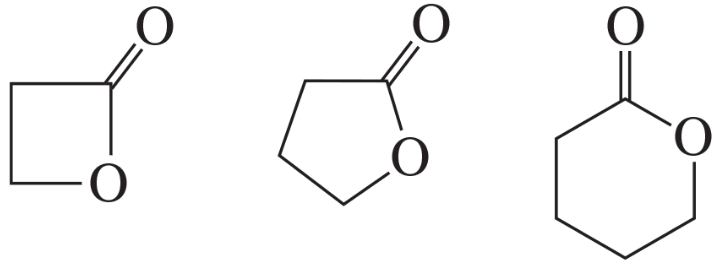
Rank the following compounds from highest wavenumber to lowest wavenumber for their C=O absorption bands:
b.

Verified step by step guidance
1
Identify the functional groups in each compound that contain a C=O bond. For example, ketones, aldehydes, esters, carboxylic acids, and amides all have C=O bonds, but their environments differ, affecting the absorption wavenumber.
Recall the general trend for C=O stretching frequencies in IR spectroscopy. The wavenumber is influenced by the electronic environment around the carbonyl group. For example, electron-withdrawing groups increase the wavenumber, while electron-donating groups or resonance effects lower it.
Consider the hybridization and resonance effects. For example, esters typically have a higher wavenumber than ketones because the lone pair on the oxygen in esters participates in resonance, reducing the electron density on the carbonyl carbon less effectively than in ketones.
Account for any conjugation effects. Conjugation with a double bond or aromatic ring lowers the C=O stretching frequency because it delocalizes the electrons, reducing the bond strength and thus the wavenumber.
Rank the compounds based on the above considerations, starting with the compound that has the least resonance or conjugation effects (highest wavenumber) and ending with the compound that has the most resonance or conjugation effects (lowest wavenumber).

Verified video answer for a similar problem:

This video solution was recommended by our tutors as helpful for the problem above.
Video duration:
9m
Was this helpful?

Key Concepts

Here are the essential concepts you must grasp in order to answer the question correctly.

Infrared Spectroscopy

Infrared spectroscopy is a technique used to identify molecular structures by measuring the absorption of infrared light by a compound. Different functional groups absorb infrared radiation at characteristic wavenumbers, which are measured in cm⁻¹. The C=O bond, for example, typically shows strong absorption in the range of 1700-1750 cm⁻¹, making it a key feature in organic compound analysis.
Recommended video:
2:56
The UV-Vis Spectroscopy Concept 1

C=O Bond Strength and Wavenumber

The strength of the C=O bond influences the wavenumber of its absorption band in infrared spectroscopy. Stronger bonds generally absorb at higher wavenumbers due to the increased energy required to stretch the bond. Factors such as hybridization and the presence of electron-withdrawing groups can also affect the bond strength and, consequently, the wavenumber of the C=O absorption.
Recommended video:
3:15
Disulfide Bonds Example 2

Functional Group Effects

Different functional groups can influence the wavenumber of C=O absorption bands through electronic effects. For instance, electron-withdrawing groups (like halogens or nitro groups) can increase the wavenumber due to increased bond polarity, while electron-donating groups can lower it. Understanding these effects is crucial for accurately ranking compounds based on their C=O absorption characteristics.
Recommended video:
Guided course
02:36
Identifying Functional Groups