Join thousands of students who trust us to help them ace their exams!
Multiple Choice
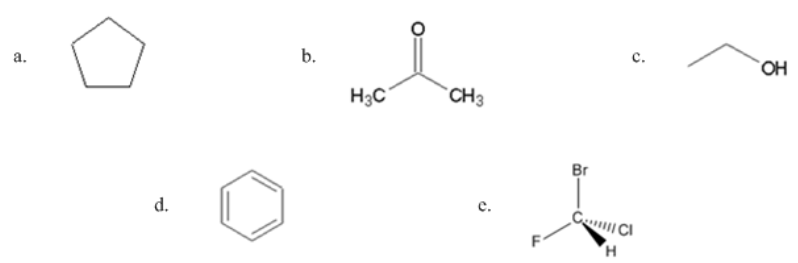
Which of the solvents are apolar and polar?
A
apolar:a, d and e; polar:c and b
B
apolar:a, c and d; polar:b and e
C
apolar:a and c; polar:b, d and e
D
apolar:a and d; polar:b, c and e
0 Comments
Verified step by step guidance
1
Step 1: Identify the chemical structure of each solvent. Solvent a is cyclopentane, solvent b is acetone, solvent c is ethanol, solvent d is benzene, and solvent e is a chiral compound with halogens attached to a carbon.
Step 2: Determine the polarity of each solvent based on its structure. Cyclopentane (a) is a non-polar hydrocarbon due to its symmetrical ring structure. Acetone (b) is polar because of the carbonyl group, which has a significant dipole moment. Ethanol (c) is polar due to the hydroxyl group, which can form hydrogen bonds.
Step 3: Analyze benzene (d), which is a non-polar solvent because of its symmetrical ring structure and delocalized electrons, which do not create a net dipole moment.
Step 4: Examine the chiral compound (e). The presence of electronegative halogens (F, Cl, Br) creates a polar molecule due to the differences in electronegativity and the asymmetrical distribution of these atoms around the central carbon.
Step 5: Based on the analysis, categorize the solvents: apolar solvents are a (cyclopentane) and d (benzene); polar solvents are b (acetone), c (ethanol), and e (chiral halogenated compound).


 Verified step by step guidance