Ch.1 - Structure and Bonding
Wade - Organic Chemistry 9th Edition
Wade9th EditionOrganic ChemistryISBN: 9780135213728Not the one you use?Change textbook
Chapter 1, Problem 5f-j

Use electronegativities to predict the direction of the dipole moments of the following bonds.
(f) N—Cl
(g) N—O
(h) N—S
(i) N—B
(j) B—Cl

Verified step by step guidance
1
Identify the electronegativity values of each element involved in the bonds. For example, nitrogen (N), chlorine (Cl), oxygen (O), sulfur (S), and boron (B) have specific electronegativity values.
Compare the electronegativity values of the two atoms in each bond. The atom with the higher electronegativity will attract the shared electrons more strongly, creating a dipole moment.
For the N—Cl bond, compare the electronegativity of nitrogen and chlorine. Determine which atom is more electronegative and predict the direction of the dipole moment towards that atom.
For the N—O bond, compare the electronegativity of nitrogen and oxygen. Determine which atom is more electronegative and predict the direction of the dipole moment towards that atom.
Repeat the process for the N—S, N—B, and B—Cl bonds, comparing the electronegativities of the atoms in each bond and predicting the direction of the dipole moment towards the more electronegative atom.

Verified video answer for a similar problem:

This video solution was recommended by our tutors as helpful for the problem above.
Video duration:
3m
Was this helpful?

Key Concepts

Here are the essential concepts you must grasp in order to answer the question correctly.

Electronegativity

Electronegativity is a measure of an atom's ability to attract and hold onto electrons within a chemical bond. In a bond between two atoms, the atom with higher electronegativity will attract the shared electrons more strongly, creating a dipole moment. Understanding electronegativity differences is crucial for predicting the direction of dipole moments in bonds.
Recommended video:
Guided course
1:47
Electronegativity

Dipole Moment

A dipole moment occurs when there is an uneven distribution of electron density in a chemical bond, resulting in a partial positive and partial negative charge. The direction of the dipole moment is from the less electronegative atom to the more electronegative atom. Dipole moments are vector quantities and are essential for understanding molecular polarity.
Recommended video:
Guided course
01:46
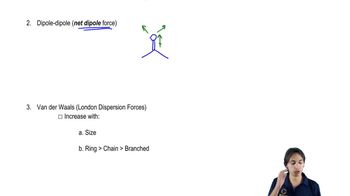
How dipole-dipole forces work.

Bond Polarity

Bond polarity arises from differences in electronegativity between two bonded atoms. A polar bond has a significant electronegativity difference, leading to a dipole moment, while a nonpolar bond has little to no difference. Recognizing bond polarity helps in predicting molecular behavior and interactions, such as solubility and reactivity.
Recommended video:
Guided course
06:00
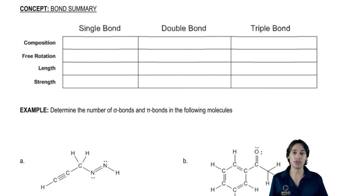
Single bonds, double bonds, and triple bonds.