
Ch.1 - Structure and Bonding
Wade - Organic Chemistry 9th Edition
Wade9th EditionOrganic ChemistryISBN: 9780135213728Not the one you use?Change textbook
Chapter 1, Problem 1b

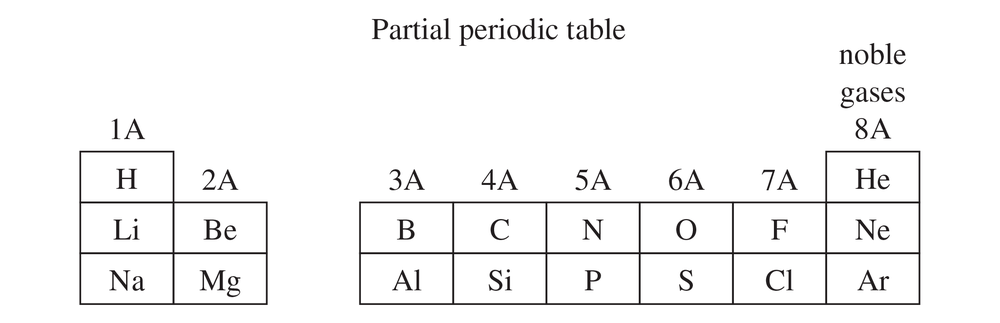
Write the electronic configurations of the third-row elements shown in the partial ­periodic table in Figure 1-6.

Verified step by step guidance
1
Identify the third-row elements in the periodic table. These elements are sodium (Na), magnesium (Mg), aluminum (Al), silicon (Si), phosphorus (P), sulfur (S), chlorine (Cl), and argon (Ar).
Understand that the electronic configuration is a representation of the distribution of electrons in an atom's orbitals. The third-row elements fill the 3s and 3p orbitals.
Start with sodium (Na), which has an atomic number of 11. Its electronic configuration is written by filling the 1s, 2s, 2p, and then the 3s orbitals: 1s22s22p63s1.
Continue with magnesium (Mg), which has an atomic number of 12. Its electronic configuration is: 1s22s22p63s2.
Proceed with the remaining elements (Al, Si, P, S, Cl, Ar) by adding electrons to the 3p orbitals, following the order of increasing atomic number and ensuring that the Pauli exclusion principle and Hund's rule are observed.

Verified video answer for a similar problem:

This video solution was recommended by our tutors as helpful for the problem above.
Video duration:
3m
Was this helpful?

Key Concepts

Here are the essential concepts you must grasp in order to answer the question correctly.

Electronic Configuration

Electronic configuration refers to the distribution of electrons in an atom's orbitals. It is typically represented using the notation that indicates the energy levels, sublevels, and the number of electrons in each sublevel, such as 1s² 2s² 2p⁶. Understanding electronic configurations helps predict an element's chemical properties and behavior.
Recommended video:
Guided course
02:14
The Electron Configuration

Periodic Table Structure

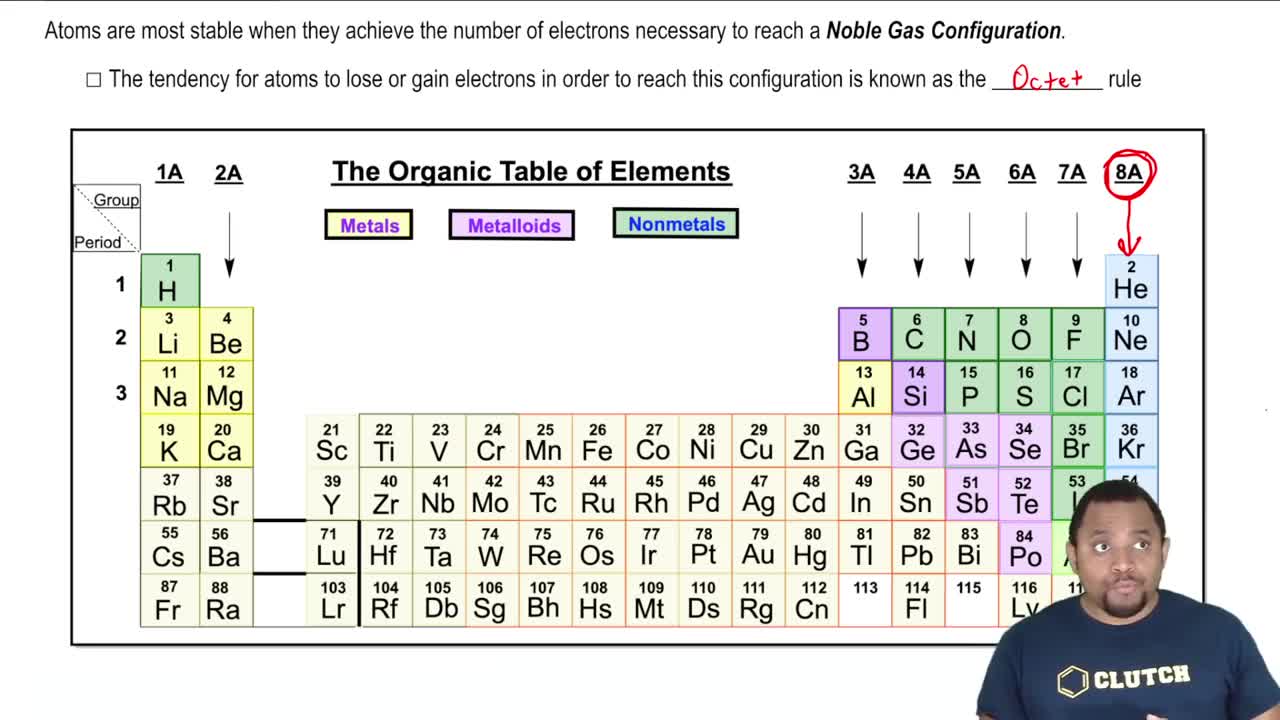
The periodic table is organized into rows called periods and columns called groups. Each period corresponds to the filling of a principal energy level with electrons. The third row, or period, includes elements where the 3s and 3p orbitals are being filled. Recognizing this structure is crucial for determining the electronic configurations of elements in a specific period.
Recommended video:
Guided course
02:24
The most important parts of the periodic table for organic chemistry

Aufbau Principle

The Aufbau principle is a guideline for determining the electron configuration of an atom. It states that electrons fill orbitals starting from the lowest energy level to higher ones. This principle, along with Hund's rule and the Pauli exclusion principle, helps in predicting the order in which atomic orbitals are filled, which is essential for writing accurate electronic configurations.
Recommended video:
Guided course
2:38
The Electron Configuration