Ch. 16 - Aromatic Compounds
Wade - Organic Chemistry 9th Edition
Wade9th EditionOrganic ChemistryISBN: 9780135213728Not the one you use?Change textbook
Chapter 16, Problem 13

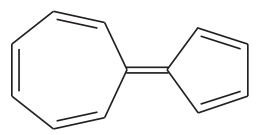
The following hydrocarbon has an unusually large dipole moment. Explain how a large dipole moment might arise.
Chemical structure of a hydrocarbon with a large dipole moment, illustrating its unique bonding and electron distribution.

Verified step by step guidance
1
Analyze the structure of the hydrocarbon provided in the image. The molecule consists of two aromatic rings connected by a single bond, with one ring being larger (likely a benzene ring) and the other smaller (likely a cyclopropane ring).
Consider the electronic properties of the two rings. The benzene ring is aromatic and has a delocalized π-electron system, which contributes to electron density. The cyclopropane ring, due to its strained geometry, has unique electronic effects that can influence dipole moment.
Evaluate the bond connecting the two rings. The single bond allows for free rotation, but the electronic effects of the rings can create an uneven distribution of electron density across the molecule.
Examine the geometry of the molecule. The non-linear arrangement of the rings can lead to an asymmetrical distribution of electron density, which contributes to the dipole moment.
Conclude that the unusually large dipole moment arises from the combination of the electron-donating or withdrawing effects of the aromatic rings, the strained geometry of the cyclopropane ring, and the asymmetrical spatial arrangement of the molecule.

Verified video answer for a similar problem:

This video solution was recommended by our tutors as helpful for the problem above.
Video duration:
2m
Was this helpful?

Key Concepts

Here are the essential concepts you must grasp in order to answer the question correctly.

Dipole Moment

A dipole moment is a measure of the separation of positive and negative charges in a molecule, resulting from differences in electronegativity between atoms. It is a vector quantity, with both magnitude and direction, indicating the polarity of a bond or molecule. A larger dipole moment suggests a greater charge separation, which can arise from uneven electron distribution due to molecular geometry or the presence of electronegative atoms.

Molecular Geometry

Molecular geometry refers to the three-dimensional arrangement of atoms within a molecule. The shape of a molecule can significantly influence its dipole moment; for instance, asymmetrical shapes can lead to a net dipole moment even if individual bonds are polar. Understanding the geometry helps predict how the molecule interacts with electric fields and other polar substances.

Electronegativity

Electronegativity is the tendency of an atom to attract electrons in a chemical bond. Differences in electronegativity between bonded atoms can create polar bonds, where one atom holds a partial negative charge and the other a partial positive charge. In hydrocarbons, the presence of highly electronegative atoms (like oxygen or nitrogen) can lead to significant dipole moments, especially when combined with specific molecular geometries.
Related Practice
Textbook Question

Explain why each compound or ion should be aromatic, antiaromatic, or nonaromatic.

(d)

(e)

(f) the [20]annulene dication

3
views

Textbook Question

When 3-chlorocyclopropene is treated with AgBF4, AgCl precipitates. The organic product can be obtained as a crystalline material, soluble in polar solvents such as nitromethane but insoluble in hexane. When the crystalline material is dissolved in nitromethane containing KCl, the original 3-chlorocyclopropene is regenerated. Determine the structure of the crystalline material, and write equations for its formation and its reaction with chloride ion.

Textbook Question

a. Explain how pyrrole is isoelectronic with the cyclopentadienyl anion.

b. Specifically, what is the difference between the cyclopentadienyl anion and pyrrole?

Textbook Question

The polarization of a carbonyl group can be represented by a pair of resonance structures:

Cyclopropenone and cycloheptatrienone are more stable than anticipated. Cyclopentadienone, however, is relatively unstable and rapidly undergoes a Diels–Alder dimerization. Explain.

2
views
Textbook Question

Repeat Problem 16-10 for the cyclopentadienyl ions. Draw one all-bonding MO, then a pair of degenerate MOs, and then a final pair of degenerate MOs. Draw the energy diagram, fill in the electrons, and confirm the electronic configurations of the cyclopentadienyl cation and anion.

1
views
Textbook Question

Explain why each compound or ion should be aromatic, antiaromatic, or nonaromatic.

(a)

(b)

(c)

2
views