Ch. 15 - Conjugated Systems, Orbital Symmetry, and Ultraviolet Spectroscopy
Wade - Organic Chemistry 9th Edition
Wade9th EditionOrganic ChemistryISBN: 9780135213728Not the one you use?Change textbook
Chapter 15, Problem 28

A solution was prepared using 0.0010 g of an unknown steroid (of molecular weight around 255) in 100 mL of ethanol. Some of this solution was placed in a 1-cm cell, and the UV spectrum was measured. This solution was found to have λmax = 235 nm, with A = 0.74.
(a) Compute the value of the molar absorptivity at 235 nm.
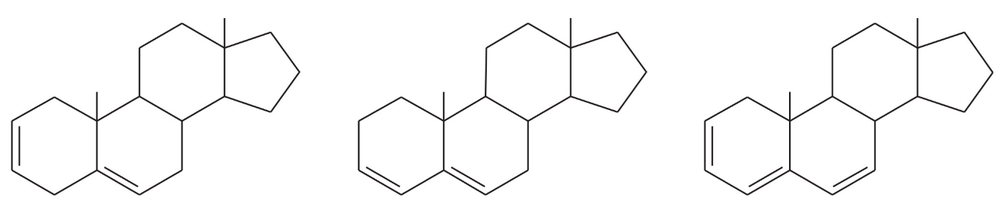
(b) Which of the following compounds might give this spectrum?

Verified step by step guidance
1
Step 1: Use the Beer-Lambert Law to calculate the molar absorptivity (ε). The Beer-Lambert Law is expressed as A = ε × c × l, where A is the absorbance, ε is the molar absorptivity, c is the concentration in mol/L, and l is the path length in cm. Rearrange the formula to solve for ε: ε = A / (c × l).
Step 2: Calculate the concentration (c) of the steroid solution. The molecular weight of the steroid is approximately 255 g/mol, and the mass of the steroid used is 0.0010 g. Use the formula c = (mass / molecular weight) / volume, where the volume is 100 mL (converted to liters: 0.1 L).
Step 3: Substitute the calculated concentration (c), absorbance (A = 0.74), and path length (l = 1 cm) into the Beer-Lambert Law equation to compute ε.
Step 4: Analyze the UV spectrum data and the λmax value (235 nm). This wavelength corresponds to the π → π* electronic transition, which is characteristic of conjugated double bonds or aromatic systems. Compare this information with the structures provided in the image.
Step 5: Examine the chemical structures in the image. Identify which compound has conjugated double bonds or aromatic systems that could absorb at 235 nm. The presence of conjugation in the steroid structure is key to matching the UV spectrum data.

Verified video answer for a similar problem:

This video solution was recommended by our tutors as helpful for the problem above.
Video duration:
4m
Was this helpful?

Key Concepts

Here are the essential concepts you must grasp in order to answer the question correctly.

Beer-Lambert Law

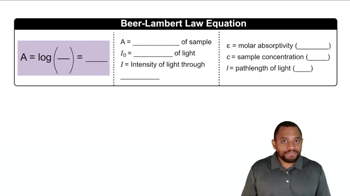
The Beer-Lambert Law relates the absorbance of light by a solution to the concentration of the absorbing species and the path length of the light. It is expressed as A = εlc, where A is absorbance, ε is molar absorptivity, l is the path length in cm, and c is the concentration in mol/L. This law is fundamental for calculating molar absorptivity from absorbance measurements.
Recommended video:
1:39
The Beer-Lambert Law Concept 2

Molar Absorptivity (ε)

Molar absorptivity, also known as molar extinction coefficient, is a measure of how strongly a chemical species absorbs light at a given wavelength. It is expressed in units of L/(mol·cm) and is specific to each compound and wavelength. A higher ε indicates a greater ability of the compound to absorb light, which is crucial for identifying compounds based on their UV spectra.
Recommended video:
Guided course
02:02
Major IR absorptions

UV-Vis Spectroscopy

UV-Vis spectroscopy is an analytical technique used to measure the absorbance of UV or visible light by a sample. It provides information about the electronic transitions in molecules, allowing for the identification of compounds based on their characteristic absorption wavelengths. The λmax indicates the wavelength at which maximum absorbance occurs, which is essential for comparing the unknown compound to known standards.
Recommended video:
2:56
The UV-Vis Spectroscopy Concept 1