Ch. 23 - Carbohydrates and Nucleic Acids
Wade - Organic Chemistry 9th Edition
Wade9th EditionOrganic ChemistryISBN: 9780135213728Not the one you use?Change textbook
Chapter 23, Problem 52b

Predict the products obtained when d-galactose reacts with each reagent.
(b) NaOH, H2O

Verified step by step guidance
1
Identify the structure of D-galactose: D-galactose is an aldohexose, meaning it contains six carbon atoms and an aldehyde functional group at the first carbon. It also has hydroxyl (-OH) groups attached to the other carbons in a specific stereochemical arrangement.
Understand the reaction conditions: The reagents NaOH and H2O indicate a basic aqueous environment. In such conditions, aldoses like D-galactose can undergo enediol rearrangement, which involves the formation of an enediol intermediate.
Describe the enediol rearrangement: The aldehyde group at C1 of D-galactose reacts with the hydroxide ion (OH⁻) to form an enolate ion. This enolate ion tautomerizes to form an enediol intermediate, which has hydroxyl groups on both C1 and C2.
Explain the possible outcomes: The enediol intermediate can rearrange back to the original aldehyde form (D-galactose) or isomerize to form other sugars. Specifically, D-galactose can isomerize to D-mannose or D-glucose, as these are epimers of D-galactose at different carbon centers (C2 and C4, respectively).
Summarize the products: The reaction in basic aqueous conditions will yield a mixture of D-galactose, D-glucose, and D-mannose due to the enediol rearrangement and isomerization processes.

Verified video answer for a similar problem:

This video solution was recommended by our tutors as helpful for the problem above.
Was this helpful?

Key Concepts

Here are the essential concepts you must grasp in order to answer the question correctly.

D-Galactose Structure

D-galactose is a six-carbon aldose sugar with a specific stereochemistry. It contains an aldehyde functional group and multiple hydroxyl groups, which influence its reactivity. Understanding its structure is crucial for predicting how it will interact with reagents like NaOH.
Recommended video:
Guided course
06:47
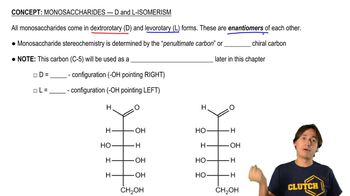
Monosaccharides - D and L Isomerism

Aldose Reactivity

Aldoses, such as d-galactose, can undergo various reactions, including oxidation, reduction, and glycosidic bond formation. In the presence of a strong base like NaOH, aldoses can undergo isomerization or aldol reactions, which are essential to consider when predicting reaction products.
Recommended video:
Guided course
01:17
Reactivity of Molecules

Base-Catalyzed Reactions

In organic chemistry, strong bases like NaOH can facilitate reactions by deprotonating functional groups or promoting nucleophilic attacks. In the case of d-galactose, NaOH can lead to the formation of an enolate ion, which can then react with water or other substrates, affecting the final products of the reaction.
Recommended video:
Guided course
01:57
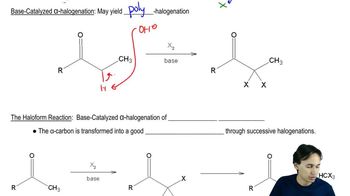
Base Catalyzed