Ch. 23 - Carbohydrates and Nucleic Acids
Wade - Organic Chemistry 9th Edition
Wade9th EditionOrganic ChemistryISBN: 9780135213728Not the one you use?Change textbook
Chapter 23, Problem 52c

Predict the products obtained when d-galactose reacts with each reagent.
(c) CH3OH, H+

Verified step by step guidance
1
Step 1: Recognize that D-galactose is an aldose sugar, specifically an aldohexose, meaning it contains an aldehyde group (-CHO) and six carbon atoms. In the presence of an acid catalyst (H⁺) and methanol (CH₃OH), the reaction will involve the formation of a glycoside.
Step 2: Understand that the reaction occurs at the anomeric carbon (C-1) of D-galactose. The aldehyde group reacts with methanol under acidic conditions to form an acetal, specifically a methyl glycoside.
Step 3: Note that the reaction produces two stereoisomers (anomers) because the newly formed glycosidic bond can adopt either an α- or β-configuration. These configurations depend on the orientation of the methoxy group (-OCH₃) relative to the ring structure.
Step 4: Write the structures of the products. The α-anomer will have the methoxy group (-OCH₃) on the opposite side of the ring relative to the CH₂OH group at C-5, while the β-anomer will have the methoxy group on the same side as the CH₂OH group.
Step 5: Conclude that the products of the reaction are α-D-galactopyranoside and β-D-galactopyranoside, where the pyranose form of D-galactose is retained, and the methoxy group replaces the hydroxyl group at the anomeric carbon.

Verified video answer for a similar problem:

This video solution was recommended by our tutors as helpful for the problem above.
Video duration:
4m
Was this helpful?

Key Concepts

Here are the essential concepts you must grasp in order to answer the question correctly.

Monosaccharide Structure

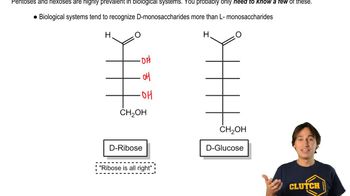
D-galactose is a monosaccharide, specifically an aldohexose, which means it contains an aldehyde group and six carbon atoms. Understanding its structure is crucial for predicting how it will react with various reagents. The configuration of the hydroxyl groups around the carbon atoms influences its reactivity and the types of products formed during chemical reactions.
Recommended video:
Guided course
06:06
Monosaccharides - Common Structures

Acid-Catalyzed Reactions

The presence of H+ indicates an acid-catalyzed reaction, which can facilitate the conversion of alcohols and sugars. In this context, the acid can protonate the hydroxyl groups of d-galactose, making them more reactive towards nucleophiles like methanol (CH3OH). This process often leads to the formation of glycosidic bonds or other derivatives, depending on the reaction conditions.
Recommended video:
Guided course
03:09
Acid Catalyzed

Methanolysis

Methanolysis refers to the reaction of a compound with methanol, often resulting in the formation of methyl ethers. In the case of d-galactose reacting with methanol in the presence of acid, the hydroxyl groups can be converted into methoxy groups, yielding methyl galactosides. This transformation is significant in carbohydrate chemistry for modifying sugars and studying their properties.