
Ch.6 - Alkyl Halides; Nucleophilic Substitution
Wade - Organic Chemistry 9th Edition
Wade9th EditionOrganic ChemistryISBN: 9780135213728Not the one you use?Change textbook
Chapter 6, Problem 38a

When tert-butyl bromide is heated with an equal amount of ethanol in an inert solvent, one of the products is ethyl tert-butyl ether.
a. What happens to the reaction rate if the concentration of ethanol is doubled?

Verified step by step guidance
1
Step 1: Recognize the type of reaction occurring. The formation of ethyl tert-butyl ether from tert-butyl bromide and ethanol suggests an SN1 reaction mechanism, as tert-butyl bromide is a tertiary alkyl halide, favoring carbocation formation.
Step 2: Understand the rate-determining step in an SN1 reaction. The rate-determining step is the formation of the carbocation intermediate, which depends only on the concentration of tert-butyl bromide and not on the concentration of ethanol.
Step 3: Analyze the role of ethanol in the reaction. Ethanol acts as a nucleophile, attacking the carbocation formed in the rate-determining step to produce the ether. However, its concentration does not affect the rate of carbocation formation.
Step 4: Predict the effect of doubling the ethanol concentration. Since the reaction rate in an SN1 mechanism is independent of the nucleophile concentration, doubling the ethanol concentration will not change the reaction rate.
Step 5: Conclude the relationship between ethanol concentration and reaction rate. The reaction rate remains unchanged when the ethanol concentration is doubled because the rate-determining step depends solely on the concentration of tert-butyl bromide.

Verified video answer for a similar problem:

This video solution was recommended by our tutors as helpful for the problem above.
Video duration:
5m
Was this helpful?

Key Concepts

Here are the essential concepts you must grasp in order to answer the question correctly.

Nucleophilic Substitution Reactions

Nucleophilic substitution reactions involve the replacement of a leaving group in a molecule by a nucleophile. In this case, ethanol acts as a nucleophile that attacks the tert-butyl bromide, leading to the formation of ethyl tert-butyl ether. Understanding the mechanism of these reactions, whether they proceed via an SN1 or SN2 pathway, is crucial for predicting how changes in reactant concentrations affect the reaction rate.
Recommended video:
Guided course
01:47
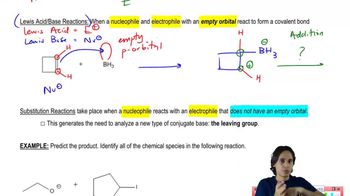
Nucleophiles and Electrophiles can react in Substitution Reactions.

Reaction Rate and Concentration

The rate of a chemical reaction is often influenced by the concentration of the reactants. According to the rate law, if the concentration of a reactant is increased, the reaction rate typically increases as well. In this scenario, doubling the concentration of ethanol would likely increase the rate of the reaction, assuming that ethanol is involved in the rate-determining step.
Recommended video:
5:07
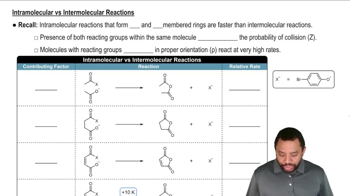
Rates of Intramolecular Reactions Concept 2

Inert Solvent Effects

Inert solvents are used in reactions to provide a medium that does not participate in the reaction itself. They can influence the reaction rate by stabilizing charged intermediates or transition states. In the case of the reaction between tert-butyl bromide and ethanol, the choice of inert solvent can affect the solvation of the reactants and products, thereby impacting the overall reaction kinetics.
Recommended video:
Guided course
01:16
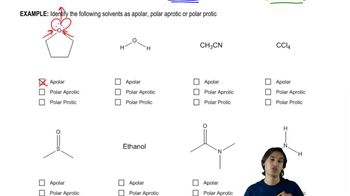
Identification of polarity in solvents
Related Practice
Textbook Question

When ethyl bromide is added to potassium tert-butoxide, the product is ethyl tert-butyl ether.

CH3CH2–Br + (CH3)3C–OK+ → (CH3)3C–O–CH2CH3 ethyl bromide potassium tert-butoxide ethyl tert-butyl ether

a. What happens to the reaction rate if the concentration of ethyl bromide is doubled?

2
views
Textbook Question

Chlorocyclohexane reacts with sodium cyanide (NaCN) in ethanol to give cyanocyclohexane. The rate of formation of cyanocyclohexane increases when a small amount of sodium iodide is added to the solution. Explain this acceleration in the rate.

2
views
Textbook Question

When ethyl bromide is added to potassium tert-butoxide, the product is ethyl tert-butyl ether.

CH3CH2–Br + (CH3)3C–OK+ → (CH3)3C–O–CH2CH3 ethyl bromide potassium tert-butoxide ethyl tert-butyl ether

b. What happens to the rate if the concentration of potassium tert-butoxide is tripled and the concentration of ethyl ­bromide is doubled?

c. What happens to the rate if the temperature is raised?

Textbook Question

When tert-butyl bromide is heated with an equal amount of ethanol in an inert solvent, one of the products is ethyl tert-butyl ether.

b. What happens to the rate if the concentration of tert-butyl bromide is tripled and the concentration of ethanol is doubled?

c. What happens to the rate if the temperature is raised?

5
views
Textbook Question

Give two syntheses for (CH3)2CH—O—CH2CH3, and explain which synthesis is better.

2
views
Textbook Question

Give the substitution products expected from solvolysis of each compound by heating in ethanol.

(a)

(b)

2
views